The Argument Sony Just Made in Federal Court
On August 21, 2026, Sony filed its legal response to a California class action lawsuit (Case No. 3:26-cv-06016) accusing the company of misleading consumers about what they actually own when they purchase a game from the PlayStation Store.
Sony's central argument: it is "not plausible to allege that reasonable consumers believed they were obtaining 'ownership' of a digital game."
That sentence — from Sony's own court filing — has circulated across virtually every gaming outlet since the document became public. Its timing compounds the controversy: Sony is simultaneously holding firm on its plan to end physical disc production for new PlayStation titles in January 2028. From that point forward, the PlayStation Store will be the only legal avenue for purchasing new PlayStation games. If Sony's legal position stands, those purchases would convey no ownership whatsoever.
Sources: Digital Trends — Sony's defense explained · IGN — PlayStation claims digital games aren't owned by players
Timeline: How We Got Here
| Date | Event |
|---|---|
| January 2025 | Sony announces end of physical disc production for new PS titles, effective January 2028 |
| March 2026 | UK class action filed — £2B claim on behalf of ~12.2M PlayStation users, led by consumer campaigner Alex Neill |
| June 18, 2026 | California class action filed — four plaintiffs, Case No. 3:26-cv-06016, Northern District of California |
| July 2026 | Mexican lawmakers file anti-competitive practices claim over disc-end decision |
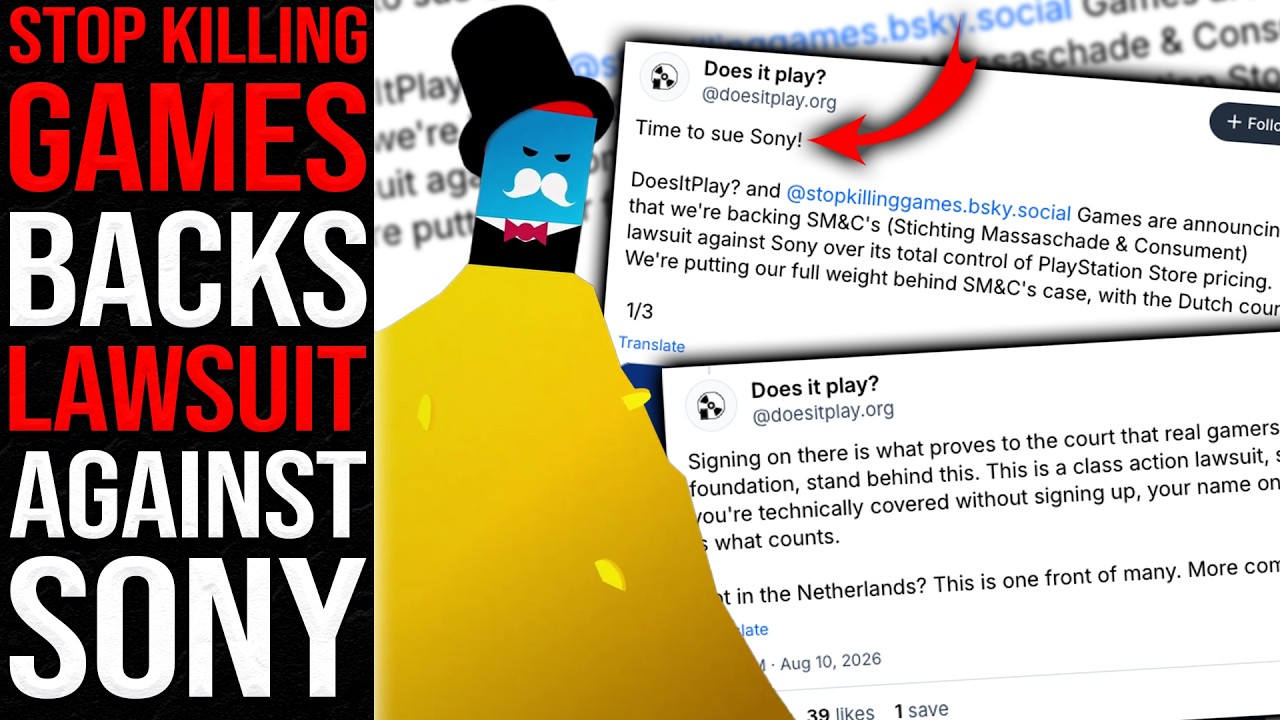
| August 10, 2026 | Stop Killing Games and DoesItPlay officially join Netherlands' "Fair PlayStation" lawsuit |
| August 21, 2026 | Sony files response: "reasonable consumers" cannot plausibly claim digital ownership |
| September 2026 | Sony CFO Lin Tao reaffirms all-digital plan — will "cautiously move this forward" |
Sony's Legal Arguments, Broken Down
The California lawsuit accuses Sony of violating California AB 2426, a consumer protection law that bars companies from using words like "buy," "purchase," or "own" when describing digital goods unless they clearly and conspicuously disclose at the point of sale that the transaction conveys a revocable license, not ownership.
The four named plaintiffs — Andrew Garcia, Edward Heycock, Jason Mendoza, and John Salinas — argue that PlayStation's checkout flow, which uses "Buy Now" and "Confirm Purchase" buttons, leads consumers to believe they own what they are paying for. The disclosures that describe the license terms, they argue, are buried in dense legal text rather than shown "clearly and conspicuously" during the transaction.
Sony's August 21 filing counters on two tracks.
Track 1 — Disclosures already satisfy the law. Sony argues that its checkout page links to the PlayStation Store License Agreement (SPLA), which states: "The Software is licensed to you, not sold." Section 10 of PlayStation's Terms of Service also specifies that "buy," "purchase," and "own" do not convey actual ownership. Sony's position is that this satisfies AB 2426's transparency requirement.
Track 2 — Digital ownership is logically impossible. This is the argument that detonated across social media. Sony's filing states:
“"As Plaintiffs admit, Section 1 of the SPLA likewise explains that 'The Software is licensed to you, not sold.' This makes sense. In the digital age, it is not plausible to allege that reasonable consumers believed they were obtaining 'ownership' of a digital game. Were that the case, then Plaintiff Edward Heycock would not have been able to obtain the game Resident Evil Requiem on February 25, 2026 for $69.99 from the PlayStation Store after Plaintiff Jason Mendoza had obtained Resident Evil Requiem on February 14, 2026, because Mr. Mendoza, not Sony, would have owned it then." — Sony's August 21, 2026 court filing (Case No. 3:26-cv-06016)
The logic: digital files are non-rivalrous goods — the fact that one person bought a game does not prevent another from buying it, which would be impossible if either buyer held genuine ownership. Therefore, Sony argues, no reasonable consumer could expect digital ownership from the outset.
Sony has also filed a motion to compel individual arbitration, a standard corporate legal maneuver intended to move the dispute out of class-action proceedings and into private arbitration, where class-wide claims cannot proceed.
Both Sides
The Case Against Sony's Argument
Three contradictions in Sony's position have driven the public backlash.
1. The checkout language. If Sony's position is that no reasonable consumer expects ownership, why does the purchase button say "Buy Now"? Sony is simultaneously arguing that the licensing distinction is already obvious to consumers and maintaining storefront language that, by any plain reading, implies ownership. As widely shared responses put it: "The page says I'm 'Buying' it. If I already knew I wasn't buying it, why does the page say 'Buy'?"
2. The 2028 disc cutoff. Physical disc production for new PlayStation games ends in January 2028. From that point, Sony's digital store is the only legal way to buy new PS titles. There is no secondhand market for digital licenses, no retailer competition on price, and no way to resell a purchased game. If Sony's legal argument holds — digital purchases convey only revocable licenses — then from 2028 onward no PlayStation game purchase will give the buyer anything resembling ownership. The California lawsuit addresses today's disclosure practices, but its outcome will define consumer rights in that entirely digital future.
3. The arbitration filing. Filing a motion to move the case into private arbitration simultaneously with arguing "reasonable consumers already know they don't own anything" reads, to many observers, as a company trying to both claim it has done nothing wrong and avoid the public scrutiny of a trial.
Sony's Position
Sony has stated that its disclosures are legally adequate and that the EULA and Terms of Service, accessible during checkout, are transparent about the licensing model. CFO Lin Tao, speaking in July 2026, said Sony will "cautiously move this forward" on the all-digital plan, adding that the company is keeping consumers' "high emotions around the topic in consideration."
Four Jurisdictions, One Core Dispute
The California case is not isolated. Sony is currently facing parallel legal challenges in four countries simultaneously:
| Jurisdiction | Claim | Scale |
|---|---|---|
| California, USA | AB 2426 — licensing not disclosed clearly at point of sale | Four named plaintiffs; class-wide scope |
| Mexico | Anti-competitive practices — disc-end creates forced digital monopoly | Filed July 2026 by lawmakers |
| Netherlands | "Fair PlayStation" — digital games cost 47% more than physical on average | €457M estimated damages; ~1.7M PS4/PS5 owners |
| United Kingdom | Price overcharging — "exploiting UK customers for nearly a decade" | £2B claim; ~12.2M PlayStation users; led by Alex Neill |
Stop Killing Games, whose primary mandate has been ensuring games remain playable after publisher server shutdowns, formally joined the Netherlands suit in August 2026 alongside game preservation group DoesItPlay. "Sony has a monopoly on digital game sales on PlayStation," the organization stated. "Once Sony stops selling physical games in 2028, you won't have any choice at all."
Why This Case Matters Beyond PlayStation
If the California court rules that Sony's existing disclosures are insufficient under AB 2426, the precedent would not be limited to PlayStation. The checkout language used by most major digital storefronts — "Buy Now," "Purchase," "Add to Library" — is functionally similar across Steam, the Epic Games Store, the Microsoft Store, and others. A ruling in the plaintiffs' favor could force how digital transactions are described across the entire PC and console market.
The outcome also determines how much legal weight Stop Killing Games' broader consumer rights expansion carries. The group's original campaign — keeping games playable after server shutdown — has a distinct legal basis from digital pricing monopoly claims, but both ultimately ask the same underlying question: what does a consumer retain after paying for digital content?
GamePeak Summary
| Item | Detail |
|---|---|
| Case | California class action — Case No. 3:26-cv-06016 |
| Filed | June 18, 2026 |
| Sony's filing | August 21, 2026 |
| Sony's core argument | "Reasonable consumers" cannot plausibly expect digital ownership |
| Current status | Motion to compel arbitration pending; case active |
| Disc-end date | January 2028 — new PlayStation titles digital-only thereafter |
| Parallel cases | Mexico, Netherlands (€457M), United Kingdom (£2B) |
The court's ruling on Sony's arbitration motion is the next major inflection point. If denied, the class action proceeds publicly. If granted, it moves to private arbitration and away from public record. Either way, the argument Sony chose to make — that digital ownership is "not plausible" for a reasonable consumer — is already a matter of public record, and it will be cited in each of the other three jurisdictions.
Sources: Digital Trends · IGN · Polygon · Kotaku — Stop Killing Games joins Sony lawsuit