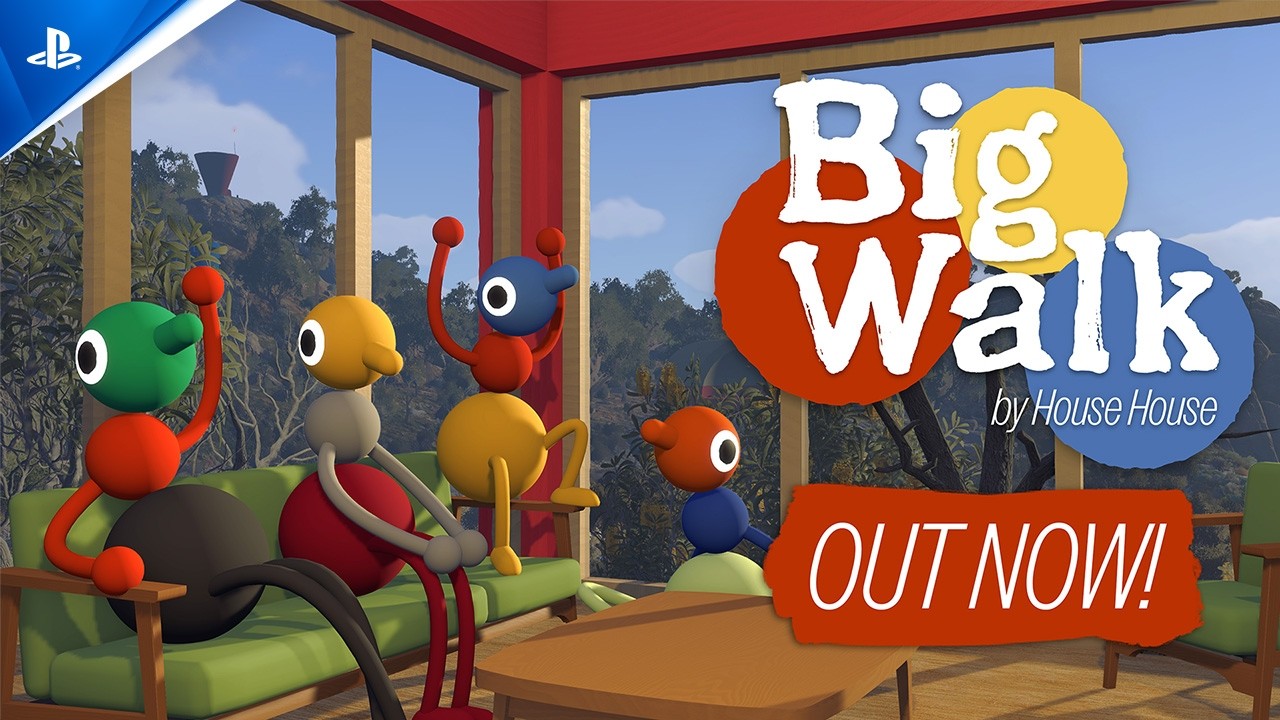
Big Walk, the cooperative multiplayer adventure from Melbourne studio House House — creators of Untitled Goose Game — launched August 4, 2026 on PC, PS5, and Nintendo Switch 2 with a 94 on Metacritic (PC version), making it the highest-rated game of 2026 on any platform. The score puts it ahead of Forza Horizon 6 and Mina the Hollower. Steam user reviews stand at 92% positive across 5,891 ratings. PS Plus Essential subscribers can claim it free through August 31, and a 25% introductory discount ($14.99) applies on Steam and Nintendo eShop through August 18.
Sources: Big Walk on Steam · Metacritic score page · Polygon review roundup · TechTimes full review
At a Glance
| Title | Big Walk |
|---|---|
| Developer | House House (Melbourne, Australia) |
| Publisher | Panic |
| Released | August 4, 2026 |
| Platforms | PC (Steam — Windows + macOS), PS5, Nintendo Switch 2 |
| Price | $19.99 full / $14.99 through August 18 |
| Players | 2–12 online co-op |
| Crossplay | PS5 ↔ PC ↔ Switch 2 via Join Code |
| Genre | Co-op adventure, open world, puzzle |
About House House
House House is a four-person studio based in Melbourne, Australia. Founders Stuart Gillespie-Cook, Nico Disseldorp, Michael McMaster, and Jake Strasser built their international reputation with Untitled Goose Game (2019), a slapstick puzzle game about a mischievous goose that became one of gaming's most widely recognized cultural moments. Big Walk is their second game — developed over six years with contributions from environment artist Kalonica Quigley, sound designer Em Halberstadt, sound programmer Nicholas Zhang, and composer AKSFX, published once again by Panic.
“"We've been working on Big Walk for six years now, and we still love playing it together. We hope you will too." — House House
Score Breakdown by Platform
| Platform | Metacritic | Reviews | Notes |
|---|---|---|---|
| PC (Steam) | 94 | 19 | Highest-rated game of 2026 |
| PS5 | 86–88 | Accumulating | Free via PS Plus through Aug 31 |
| Nintendo Switch 2 | 77 | Accumulating | Technical issues reported at launch |
- ▶Steam user score: Very Positive — 92% of 5,891 reviews
- ▶OpenCritic: 89
Where Critics Stood
| Outlet | Score | Key statement |
|---|---|---|
| Eurogamer | ★★★★★ | "A funny, exciting, and deeply rewarding multiplayer adventure that combines knockabout fun with some surprisingly big ideas." |
| GameSpot | 9/10 | "One of the best co-op games ever." |
| Checkpoint Gaming | 95/100 | "Powerfully examines and challenges communication in a way rarely seen in any other title." |
| Polygon | Recommended | Described it as "a summer camp where you walk away even closer to your friends." |
| Restart | ★★★★★ | "There's a lot of puzzles in Big Walk and as our group did more and more, we got better and better at learning to communicate within the game's absurd contexts." |
The Problem Big Walk Was Built to Solve
The dominant co-op formula of the past two years has a name critics gave it in early 2025: friendslop. Games like Lethal Company, R.E.P.O., and PEAK share a structural pattern — a minimal game loop (extraction quota, survival timer, physics chaos) that assumes players supply the comedy and momentum. PEAK developer Caelan Pollock defined it plainly: friendslop is "something that assumes that you and your friends will make up the difference in comedy and interaction in what the game is lacking."
House House built Big Walk to invert that model. PC Gamer's Morgan Park wrote the day before launch: "If Peak is Jenga, fun and repeatable but always the same, Big Walk is a proper campaign — a group project you begin and finish."
The implication is literal. Big Walk has a handcrafted open-world island to explore, puzzles that require real coordination to solve, and an actual ending. The studio described the game directly as "a hand-crafted cooperative adventure meant to be played start-to-finish with a group of friends." A complete playthrough takes 10–15 hours. There is no daily login reward, no grind loop, no season pass.
Proximity Chat as a Design Layer
The decision that most clearly separates Big Walk from any co-op game of recent years is treating proximity voice chat not as a convenience option but as the primary puzzle layer.
In most multiplayer games, voice communication is external to the experience — you connect via Discord regardless of where players stand in the game world. Big Walk builds its entire puzzle structure around the spatial properties of in-game audio:
- ▶Voices fade as players move apart across the island
- ▶Sound echoes through corridors and cave systems
- ▶Walls and closed doors muffle speech
- ▶Walkie-talkies transmit voice with static and compression
- ▶A megaphone broadcasts loudly but without nuance or directionality
- ▶Binoculars let you observe a teammate across a valley — but you cannot speak to them
This is not atmospheric window dressing. It is the design. As Restart's Imran Khan wrote: "There's a lot of puzzles in Big Walk and as our group did more and more, we got better and better at learning to communicate within the game's absurd contexts, at interpreting how each other think, at knowing exactly what it means when someone sits down and raises their arms above their heads." Bypassing this with Discord does not improve the experience — it removes the constraints that generate the puzzles.
For players without microphones, text chat operates under the same spatial rules — visibility is also distance-dependent — making the full experience accessible without a headset.
Communication Tools
| Tool | Function |
|---|---|
| Walkie-talkie | Long-range voice (with static and crackle) |
| Laser pointer | Direction indicator |
| Binoculars | Long-range observation (no audio) |
| Megaphone | Wide broadcast, no nuance |
| Whiteboard | Written coordination |
| Flares and cowbells | Attention-getting signals |
The Object With No Name
Clearing a puzzle section drops an abstract, lumpy red shape as a reward. House House deliberately gave it no in-game identifier. Every group of players must invent their own name for it — and then use it consistently to coordinate. Publisher Panic's CEO Cabel Sasser documented what players called it during preview sessions at the Panic Portland office: "the avocado," "watchamacalit," "the red thing," "bowling pin," "the apparatus," "my son," "pawn," and "doodad."
Critics' playthroughs produced their own lexicons: "kongs," "gourds," "babies," "red peanuts," "jelly babies," "eggy things," and "nipples."
The deliberate namelessness is not a quirk. The act of naming something together, and then relying on that name in tense moments, is exactly the kind of shared language the game is engineered to build between players.
Flexible Group Size
When starting a session, the host selects a 2-player, 3-player, or 4+ player configuration. The island's puzzle layout then changes to structurally match the group — this is not cosmetic scaling. A two-player session encounters different puzzle configurations than a twelve-player one. House House designed the game to support everything from a focused two-person collaboration to what they describe as "an absolute mess."
PC System Requirements
| Minimum | Recommended | |
|---|---|---|
| OS | Windows 10 | Windows 11 |
| CPU | Intel i7-7700K / AMD R5 1600X | Intel i5-10600K / R7 3700X |
| RAM | 12 GB | 16 GB |
| GPU | GTX 750 Ti / R7 370 / Arc A380 | GTX 1070 / RX 5600 XT / Arc A750 |
macOS support requires Apple Silicon M1 or newer (macOS 15).
Buying Options
| Option | Price | Notes |
|---|---|---|
| PS Plus Essential | Free | Claim by August 31 — PS5 version only |
| Steam (launch discount) | $14.99 | Through August 18 |
| Nintendo eShop (launch discount) | $14.99 | Through August 18 |
| Steam (full price) | $19.99 | From August 19 |
| Big Walk + PEAK Bundle (Steam) | $17.08 | ~32% combined discount |
The Big Walk and PEAK bundle on Steam is a particularly strong value — it covers both defining co-op releases of 2025–2026 for under $18. PS Plus Essential subscribers should claim the PS5 version now regardless of preferred platform, since crossplay via Join Code allows PS5 players to join PC and Switch 2 sessions.
Big Walk is not built around a loop. It is built around an ending — and everything between the opening moment and the final scene is designed to pull the people playing together closer to each other. Whether a two-player focused run or a twelve-person expedition, the experience adapts to the group. The 94 on Metacritic reflects what six years of deliberate, uncompromising game design — from a studio of four people — can produce.