| Developer | LocalThunk |
|---|---|
| Platforms | PC, macOS, iOS, Android |
| Price | $12.99 |
| Steam | Buy Balatro on Steam |
| Steam Rating | Overwhelmingly Positive (370,000+ reviews) |
“"I lost three hours on my first run and won nothing. By run twelve I was staying up until 3 AM calculating Joker interactions I'd read about in the shower." — r/Balatro, 4.7k upvotes
That experience is not unusual. Balatro is a deceptively simple game that rewards players who understand its math — and punishes those who treat it like a luck-based card game. This guide is for players who want to stop relying on luck and start building intentionally.
What Is Balatro?
Balatro is a poker-based roguelike deckbuilder developed solo by LocalThunk and published by Playstack. You play standard poker hands — pairs, two pairs, straights, flushes, full houses, and so on — against escalating score targets called Blinds. Each hand generates Chips and a Multiplier (Mult). Multiply them together and that's your score.
Here is the core formula that governs every run:
Score = Chips × Mult
Simple enough. But layered on top of the hand system is a pool of 150+ Jokers — unique passive cards you equip up to five at once — that modify, amplify, and chain that formula into something exponential. A starting hand worth 200 points becomes 200 million points by the end of a high-level run, and every intermediate step is the result of specific Joker interactions you deliberately built toward.
This is not luck. This is math.
🎬 Official Trailer
The Scoring System: Chips × Mult
Before any Joker touches your score, every hand type carries a base Chips value and a base Mult value. Planet cards in the shop upgrade these permanently, so your baseline matters from the very first blind.
Base Hand Values (Level 1)
| Hand | Base Chips | Base Mult | Level 1 Score Example |
|---|---|---|---|
| High Card | 5 | 1 | 5 |
| Pair | 10 | 2 | 20 |
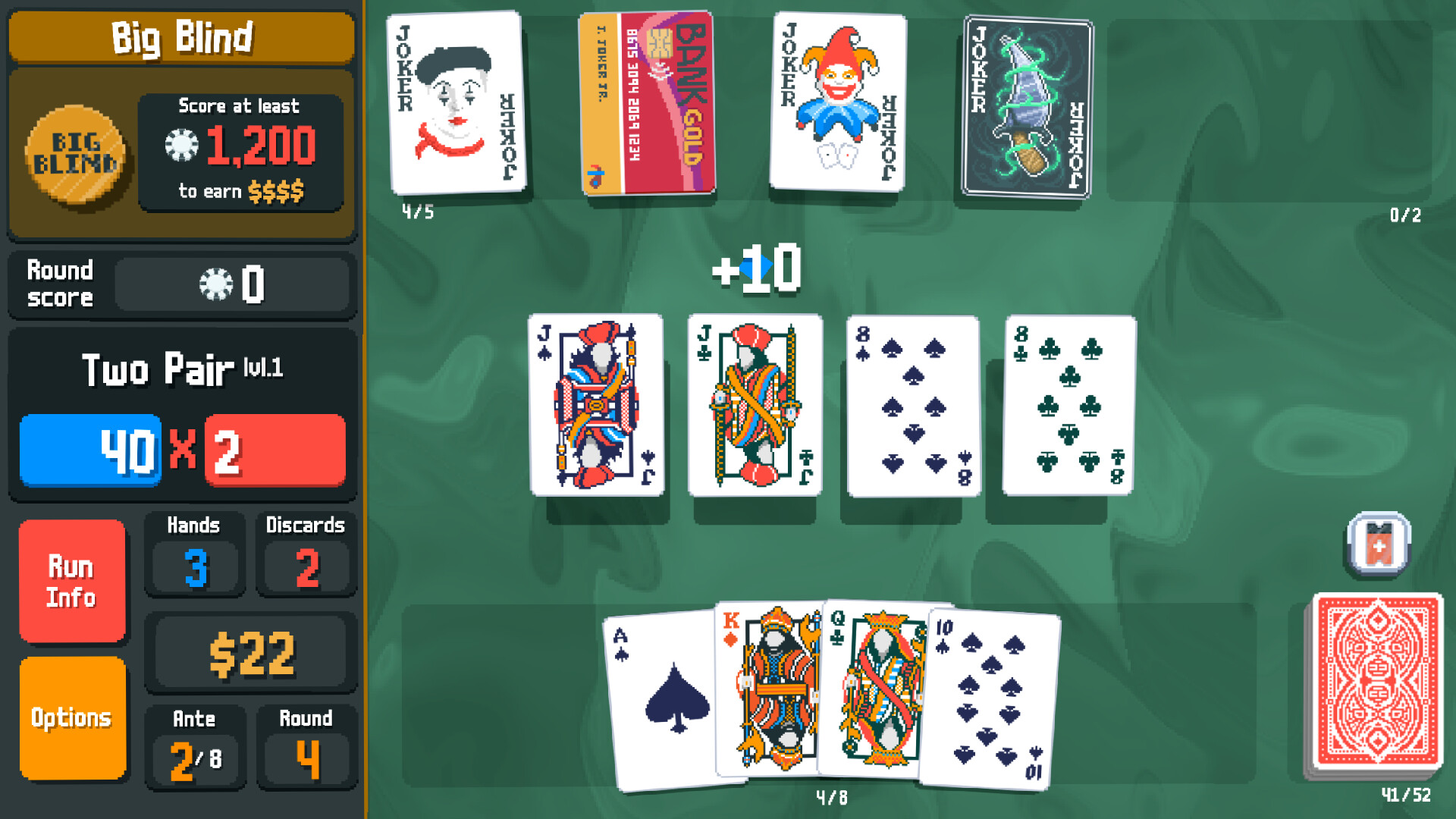
| Two Pair | 20 | 2 | 40 |
| Three of a Kind | 30 | 3 | 90 |
| Straight | 30 | 4 | 120 |
| Flush | 35 | 4 | 140 |
| Full House | 40 | 4 | 160 |
| Four of a Kind | 60 | 7 | 420 |
| Straight Flush | 100 | 8 | 800 |
| Royal Flush | 100 | 8 | 800 |
| Five of a Kind | 120 | 12 | 1,440 |
| Flush Five | 160 | 16 | 2,560 |
| Flush House | 140 | 14 | 1,960 |
Scoring cards also contribute their own chip value: numbered cards are worth their face value, face cards (J/Q/K) are worth 10 chips each, and Aces are worth 11. Only cards that are part of the played hand contribute chips — held cards only matter for Joker triggers.
Planet cards upgrade both the base chips and base mult for a specific hand each time you use one. Stack five Mercury cards (the Two Pair planet) and your Two Pair becomes a legitimate scoring tool instead of a fallback play. The implication: your Planet card purchases should be driven entirely by your hand strategy, not by price.
Core Strategy 1: Understanding Joker Types
Jokers are the center of every Balatro run. Knowing how to read them — and how they interact — is the single most important skill gap between players who clear Ante 8 and those who stall in Ante 5.
+Mult vs ×Mult: The Math That Changes Everything
There are two fundamentally different categories of multiplier modification, and they are not equal.
+Mult Jokers add a flat value to your current Mult.
- ▶Example: Your hand has a base Mult of 4. A Joker gives +30 Mult. Your Mult becomes 34.
×Mult Jokers multiply your current total Mult (including all accumulated +Mult).
- ▶Example: Your Mult is 34 (after all additions). A ×3 Joker makes it 102.
This is not a minor distinction. A +30 and a ×3 look numerically similar in isolation. At Mult 4, +30 gives you 34 while ×3 gives you 12. But after your Mult has already reached 60 through other sources, ×3 gives you 180. ×Mult scales with everything that came before it. Stack your +Mult sources first, then apply your ×Mult Jokers after — Joker order in your slots directly determines when each effect fires.
Key Jokers to Recognize
Blueprint — Copies the ability of the Joker immediately to its left. Position your strongest Joker in slot 1, Blueprint in slot 2, and you effectively have that Joker twice. Used with a high-value ×Mult Joker, this is one of the most powerful shop pickups in the game.
Brainstorm — Copies the ability of the leftmost Joker. Unlike Blueprint, it doesn't need to be adjacent. Combine with Blueprint for three copies of your anchor Joker if positioning allows. These two together form a copy chain that requires deliberate slot arrangement.
Baron — Each King held in your hand (not played — held) gives ×1.5 Mult. Four Kings held means ×1.5⁴ = approximately ×5.06 Mult before anything else fires. The King-centric builds around Baron are among the highest ceiling strategies in the game.
Mime — Retriggers the held-hand bonus of every card in your hand. If Baron is active, Mime retriggers Baron's held-card effect — your Kings just multiplied again. Mime + Baron is the clearest example of how retrigger effects interact with held-card Jokers.
Hack — Retriggers scoring for cards with values 2, 3, 4, and 5. In a deck built around low-card flushing, Hack can cause each played card to score twice, tripling or quadrupling your effective chip contribution per hand.
Dusk — Retriggers all played cards on your final hand of each round. Combine with any chip-heavy configuration and your last hand of the round can carry your entire score. This rewards precise resource management — don't waste hands if Dusk is your anchor.
Fibonacci — +8 Mult each time an Ace, 2, 3, 5, or 8 scores. In a flush with five Fibonacci-eligible cards, that's +40 Mult per hand. In a deck that repeatedly hits these numbers, Fibonacci is reliably one of the strongest flat-Mult sources available.
Wee Joker — Gains +8 chips every time a 2 scores. Small number, but it stacks permanently on the Joker itself — given enough hands, Wee Joker can become a chip behemoth on its own.
Blueprint/Brainstorm Copy Combos
When constructing a copy combo, the priority is always: what is the strongest single Joker ability worth doubling? The top candidates are:
- 1Any high-value ×Mult Joker (doubling a ×2 that applies after a large Mult sum is transformative)
- 2A chip-heavy Joker that's accumulated many stacks (doubling Wee Joker copies its current full chip value, not just the base)
- 3A conditional Joker that already fires reliably in your build (don't double a Joker whose trigger condition you sometimes miss)
Blueprint position is rigid — it always copies the Joker to its left, so slot assignment matters. Brainstorm always copies the leftmost Joker, giving it more flexibility but requiring that your leftmost slot remain optimized.
Core Strategy 2: Build Specialization
Balatro does not reward generalists. A run that tries to play two different hand types with two unrelated Joker synergies will be consistently outscored by a run that commits fully to one strategy. The question at every shop visit is not "is this Joker strong?" — it is "does this Joker make my specific build stronger?"
Flush Build — The Best Beginner Foundation
What it is: Play five-card flushes every hand. Scale through Jupiter (flush Planet card), flush-boosting Jokers, and suit-restriction enhancements.
Why it works: Flush has a strong base (35 chips × 4 mult), a dedicated Planet card that's consistently available (Jupiter), and some of the game's most powerful Jokers explicitly support it. You can build toward this reliably even on lower-stakes runs.
Key Jokers to look for: Smeared Joker (suits count double, expanding flush eligibility), Four Fingers (flushes and straights can be made with four cards — opens up deck-thinning possibilities), Shortcut (straights can have gaps — synergizes with Flush Straight hybrids).
Deck construction: Delete off-suit cards aggressively. A deck of 52 cards where half are the wrong suit destroys flush consistency. Aim for 20–24 cards, predominantly one or two suits. Tarot cards that change suit (The Hierophant, etc.) are high priority.
Planet priority: Buy every Jupiter you see. Each use permanently upgrades your flush's base Chips and Mult. By Ante 6–7, a Jupiter-stacked flush baseline dwarfs what unupgraded hands achieve.
High Card Build — The Late-Game Specialist
What it is: Play a single high card every hand (or a very small hand), using Jokers that amplify held cards or single-card scoring to absurd levels.
Why it works: Jokers like Baron and Mime trigger based on held cards, not played cards. When you play only one card, four Kings sit in hand and trigger Baron every time. The math compounds extraordinarily fast.
Key Jokers: Baron (×1.5 per King held), Mime (retriggers held-card effects), The Duo/Tribe (×Mult bonuses for holding specific hand configurations), Shoot the Moon (each Queen held gives +13 Mult).
Deck construction: Heavily filter toward Kings and one or two key cards to play. Deck size should be small — under 20 cards — to maintain consistency. Face-card enhancers (Gold, Wild) amplify held-card triggers.
Difficulty: This build is weaker in early Antes because the Joker requirements are specific. Commit to it when Baron appears; if you don't see Baron, it's not your run for this strategy.
Full House Build — Mid-Game Power Spike
What it is: Build a deck engineered to consistently hit Full House every hand. Full House's Planet card (Ceres) upgrades both its chip and mult values efficiently, and several Jokers specifically boost paired hand types.
Why it works: Full House sits at a higher base value than most beginner hands and its trigger requirements (three-of-a-kind plus pair) can be controlled through deck construction. The Trio and Family Jokers (conditional ×Mult for holding specific card groupings) sync naturally.
Key Jokers: Riff-Raff (common pairs appear in your hand more often), Supernova (adds Mult equal to the number of times you've played your primary hand), The Family (×Mult bonus when holding a full house-eligible configuration).
Deck construction: Concentrate on four to six card values, with multiple copies of each. Wild cards and card-transformation Tarots help force the required groupings. Deck size in the 18–24 range is standard.
Core Strategy 3: Economy Management
Money is not just a resource for buying cards — it is a multiplier for your run's power ceiling through the interest system. Mismanaging economy is how otherwise solid runs stall in Act 4 when they run out of purchasing power for the Jokers they need.
The Interest Table
| Dollars Held at Round End | Interest Earned |
|---|---|
| $5–$9 | $1 |
| $10–$14 | $2 |
| $15–$19 | $3 |
| $20–$24 | $4 |
| $25+ | $5 (maximum) |
You receive interest after each round ends and before the next shop opens. Holding $25 at round end earns you $5 — a 20% return. The practical implication: spending down to $3 on a marginal purchase costs you $4 in lost interest over the next two rounds. That $4 is often worth more than what you bought.
When to save: Early Antes (1–3), when your build isn't defined yet. Accumulate cash, earn interest, wait for a Joker that genuinely fits your strategy rather than buying the best available thing regardless of synergy.
When to spend aggressively: When a critical Joker for your build appears in the shop, buy it regardless of what it does to your economy. A build-defining Joker is worth more than two rounds of interest income.
Selling Jokers: Don't sell a Joker unless the replacement is strictly better for your strategy. A sold Joker cannot return. In later stakes, sell values are reduced further — factor this into early decisions about Joker slotting.
Boss Blind Effects to Prioritize Watching
Certain Boss Blinds impose conditions that can invalidate strategies or cause run-ending damage if you're unprepared:
The Plant — All face cards are debuffed (they score 0 chips). Face-card-heavy or King-build runs need to either skip this blind (if the tag is good) or play a non-face-card hand temporarily.
The Needle — You can only play one hand. If your scoring strategy requires multiple hands to build Mult, plan your deck so that one hand is enough. Saves are not available here.
The Water — Discards cost $2 each. Budget accordingly — do not plan on heavy discarding for hand sculpting.
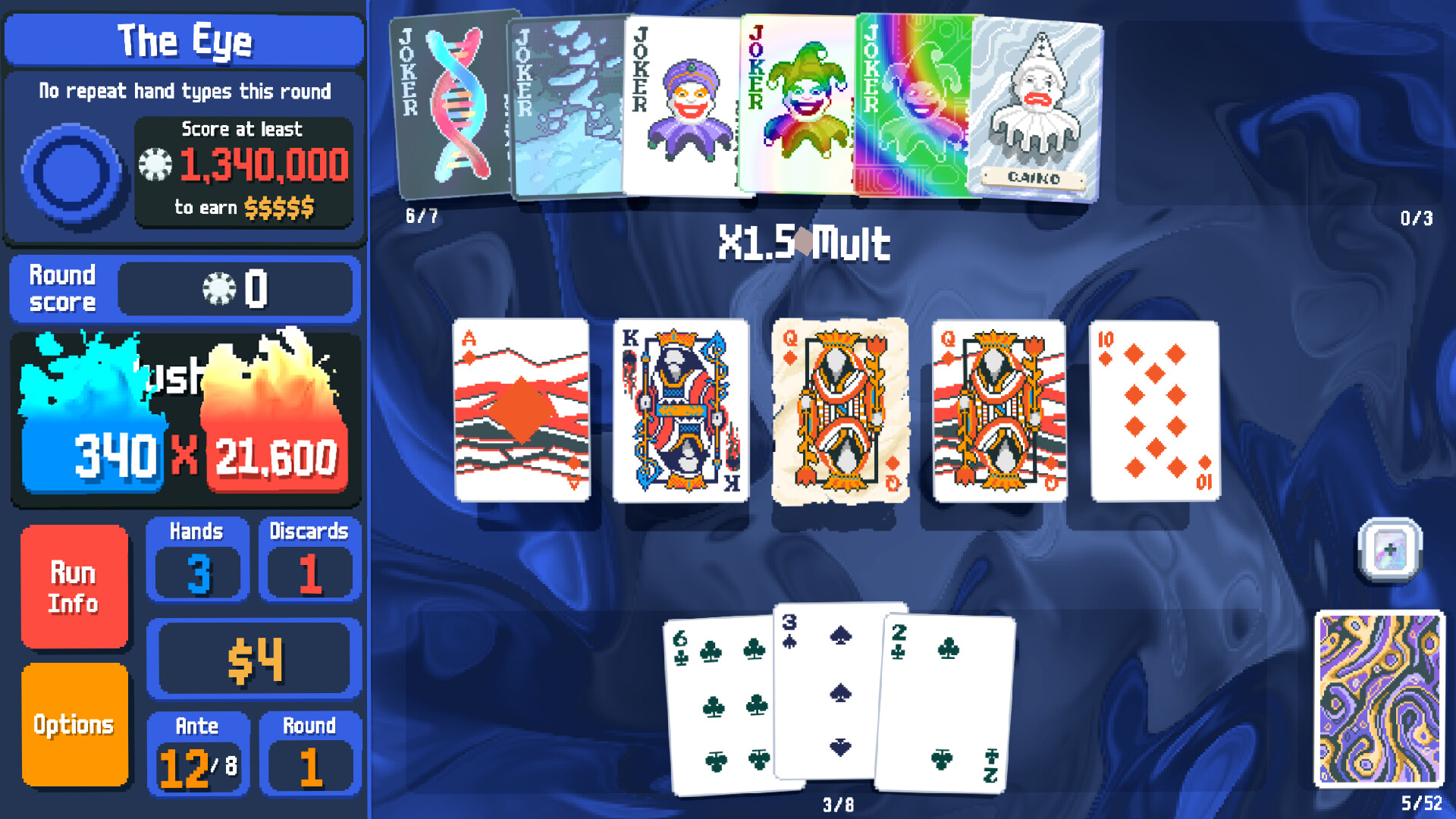
The Eye / The Mouth — Each round, only one hand type can be played. Decks that rely on flexibility across hand types are particularly vulnerable. Flush-only or Pair-only runs thrive here; generalist runs struggle.
The Mark — All face cards are flipped face-down (hidden from view). Doesn't change their value, but you can't see their rank — affects any strategy requiring deliberate hand selection by rank.
Before facing a Boss Blind, re-read its condition. Adjust your planned hands accordingly. A strong run does not die to a Boss Blind effect — it adapts.
Core Strategy 4: Tarot and Spectral Cards
Tarot and Spectral cards appear in packs and occasionally in the shop. They are consumed on use and affect individual cards in your deck permanently. Treating them as afterthoughts is a mistake — the right Tarot at the right moment is equivalent to a Joker in power.
Key Tarot Cards
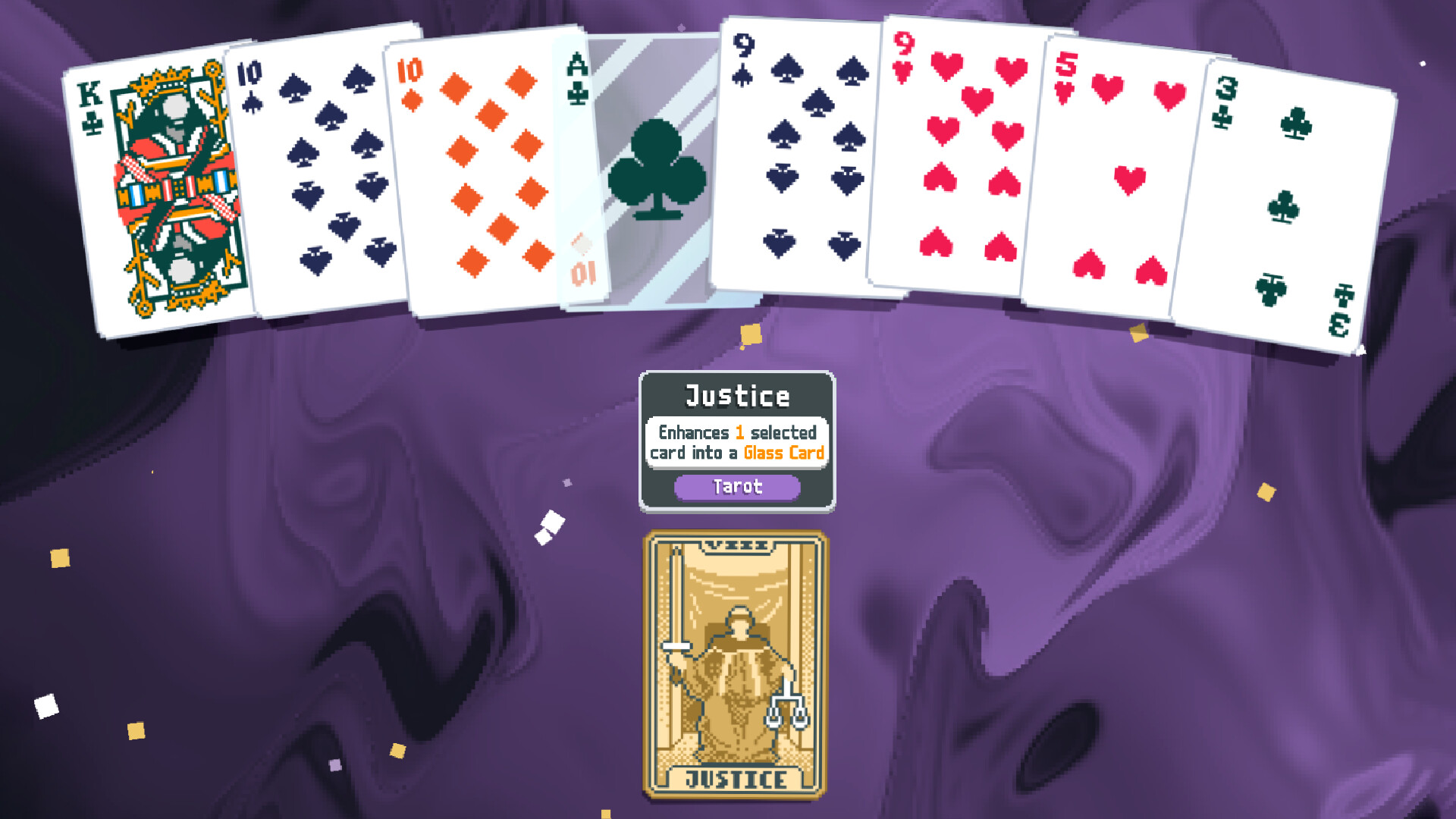
The Empress — Adds a Mult enhancement (+4 Mult each time the card scores) to two selected cards. In a flush build where you control which cards score every hand, this is permanent multiplicative accumulation.
The Star — Converts two selected cards to Diamonds. Use to force suit consistency in a flush build. Pair with other suit-conversion Tarots for a near-monochromatic deck.
The Hierophant — Adds a Bonus Chip enhancement (+30 chips) to two cards. Stacks with The Hierophant uses — if you find three of them, two of your cards are generating +90 chips just from enhancements.
The World — Adds a Foil enhancement to two cards (Foil = +50 chips). Valuable for chip-heavy strategies.
The High Priestess — Creates two Planet cards. If your hand is flush and you desperately need Jupiter, this is occasionally more valuable than a direct purchase.
Death — Copies the enhancement, edition, and seal of the left card onto the right card. Powerful when duplicating Gold, Foil, Holographic, or Polychrome editions. Also transfers seals — a Red Seal card (retrigger on one held card) copied to a Baron-relevant King is meaningful.
Spectral Cards
Spectrals are rarer and more volatile than Tarots. They can reshape a run dramatically in both directions.
Aura — Adds a Foil, Holographic, or Polychrome edition to one selected card. Polychrome (+×1.5 Mult every time the card scores) on a frequently-scoring card is among the highest-value single-card upgrades possible.
Ectoplasm — Adds a Negative edition to a Joker (removes its slot cost, giving you effectively six Joker slots), but adds $1 to all shop prices permanently. Use when you have a Joker that synergizes with having a sixth slot, or when the Joker itself is worth the permanent economic tax.
Ankh — Creates a copy of one of your Jokers (random selection) and destroys the rest. High variance. Avoid unless your run is otherwise dead and you have one exceptional Joker worth preserving.
Talisman — Adds a Gold Seal to a selected card. Gold Seal = gain $4 whenever the card is scored while remaining in hand (not played). In a High Card build where you hold four Kings every hand, Gold Seal Kings generate significant passive income.
Hex — Adds a Polychrome edition to a random Joker but destroys all others. Similar risk profile to Ankh — last-resort or high-confidence gamble only.
Seed System and Challenge Mode
Seeds
Balatro uses a seed system that allows you to replay exact run conditions by entering a specific seed string before starting a run. The seed determines Joker offerings, shop inventory, blind order, and pack contents for the entire run.
Practical uses:
- ▶Share a seed with other players to compete on identical starting conditions
- ▶Revisit a run where you made a suboptimal build decision to explore alternate paths
- ▶Practice specific Joker combinations that you rarely encounter naturally
To input a seed, select it at the run creation screen. Note that seeded runs are ineligible for some leaderboard tracking — this varies by version and platform.
Challenge Mode
Once you clear Ante 8 on standard runs, Challenge Mode unlocks preset runs with modified rules, unusual starting decks, or restriction conditions that force non-standard play. There are 20 challenges total, each designed to push a specific skill or strategy.
Notable challenges:
- ▶Jokerless — No Jokers appear. Every point comes from hand values, Planet upgrades, and card enhancements only. Forces deep understanding of base scoring and economy.
- ▶Mad World — Only 2s appear in the deck. All hand diversity disappears; build entirely around the 2's scoring capabilities.
- ▶Typecast — Each hand type can only be played once per round. Strict hand diversity requirement.
- ▶Red Door — All decks use the Erratic Deck rules. Extreme randomness — adapt aggressively.
Completing all 20 challenges is a meaningful accomplishment. Several of them require fundamentally different approaches than standard runs — they teach Balatro's edge cases more effectively than any amount of standard play.
Common Beginner Mistakes
1. Treating all Jokers as equal.
A Joker that gives +15 Mult unconditionally is not automatically worse than one that gives +50 Mult conditionally. Context — your current hand strategy, what other Jokers you hold, what Ante you're entering — determines value. Evaluate Jokers in context, not in isolation.
2. Not committing to a hand type early.
The most reliable runs decide on a primary hand type by Ante 2. Staying uncommitted past Ante 3 means your Planet card upgrades are scattered, your Jokers have no coherent synergy, and your shop purchases pull in different directions. Pick a hand. Build toward it. Deviate only when a pivot opportunity is clearly superior.
3. Prioritizing deck size over deck quality.
More cards means your key cards appear less frequently. The base deck has 52 cards — you want to trim it, not maintain it. Use Tarot cards and shop upgrades to delete weak cards. A 26-card deck with strong enhancements beats a 52-card deck with unenhanced generalists every Ante.
4. Spending all money before interest.
This is covered in Economy section but it bears repeating: if you spend down to $2 at the end of every round, you earn $0 interest. Players who maintain $20–25 consistently compound their purchasing power run over run.
5. Ignoring blind tags.
Every small and large blind can be skipped for a Tag reward. Tags can grant free packs, bonus cash, negative-edition free Jokers, extra hands, and more. Skipping a difficult blind is a strategic choice, not a forfeit. Many strong runs deliberately skip multiple blinds when the tag value exceeds the benefit of beating the blind.
6. Confusing +Mult and ×Mult.
Revisit the math section above. This is the most frequently misunderstood mechanical distinction in Balatro. Placing a ×Mult Joker before your +Mult Jokers in the slot order means it applies first — to a lower accumulated Mult. The sequence of Joker slots is not cosmetic.
7. Selling Jokers carelessly.
Once a Joker is sold, it's gone. Synergy Jokers that seem expendable because the run is going well are often load-bearing — remove one piece and the scoring chain underperforms. Before selling, trace every interaction the Joker participates in and confirm nothing breaks.
Balatro rewards players who approach it like a puzzle rather than a card game. The hands are just the interface. The actual game is reading a Joker pool, identifying the intersection of what's available and what's achievable, and building toward it with discipline. Every run that fails teaches something. Every run that wins is a blueprint for the next.
Buy on Steam: Balatro — $12.99