Editor's note: this article summarizes published reviews, store data and community reception. GamePeak did not run its own playtest, so no GamePeak score is given.
# Returnal — The Bullet-Hell Roguelike That Refuses to Let You Go
Why Returnal Matters
There are games that do things well, and there are games that do things no one else thought to do. Returnal belongs firmly in the second category.
When Housemarque — a Finnish studio with a legacy stretching back through Super Stardust HD, Resogun, and Nex Machina — released Returnal as a PS5 launch-window title in April 2021, the gaming world did a double-take. Here was a Sony first-party exclusive that combined the relentless pattern density of a 2D bullet-hell shooter with the spatial awareness demands of a third-person action game, wrapped inside a roguelike structure built from narrative mystery and psychological dread. It was one of the most original action games in years. Two years later, it arrived on PC and proved just as devastating on a new platform.
This is not a game for every player. But for the players it is for, it is close to irreplaceable.
Background: Housemarque's Leap
Housemarque spent the better part of three decades mastering arcade-style action. Resogun (2013) remains among the finest arcade shooters ever made. But the studio's ambitions eventually outgrew the twin-stick format, and Returnal was the result — a full third-person 3D world built with the same design philosophy that made their 2D games so compulsive: everything is a bullet, everything has a pattern, and survival is a matter of reading chaos and carving a line through it.
The decision to anchor the game in a roguelike structure was deliberate. Director Harry Krueger and narrative director Gregory Louden conceived the loop not just as a mechanical system but as the story itself. Selene Vassos — an ASTRA Corporation scout pilot — crash-lands on Atropos and dies. Then she wakes up next to her crashed ship and begins again. The cycle of death and rebirth is not a game mechanic layered over a story. The game mechanic is the story.
That distinction turns out to matter enormously for how Returnal feels to play.
The World of Atropos
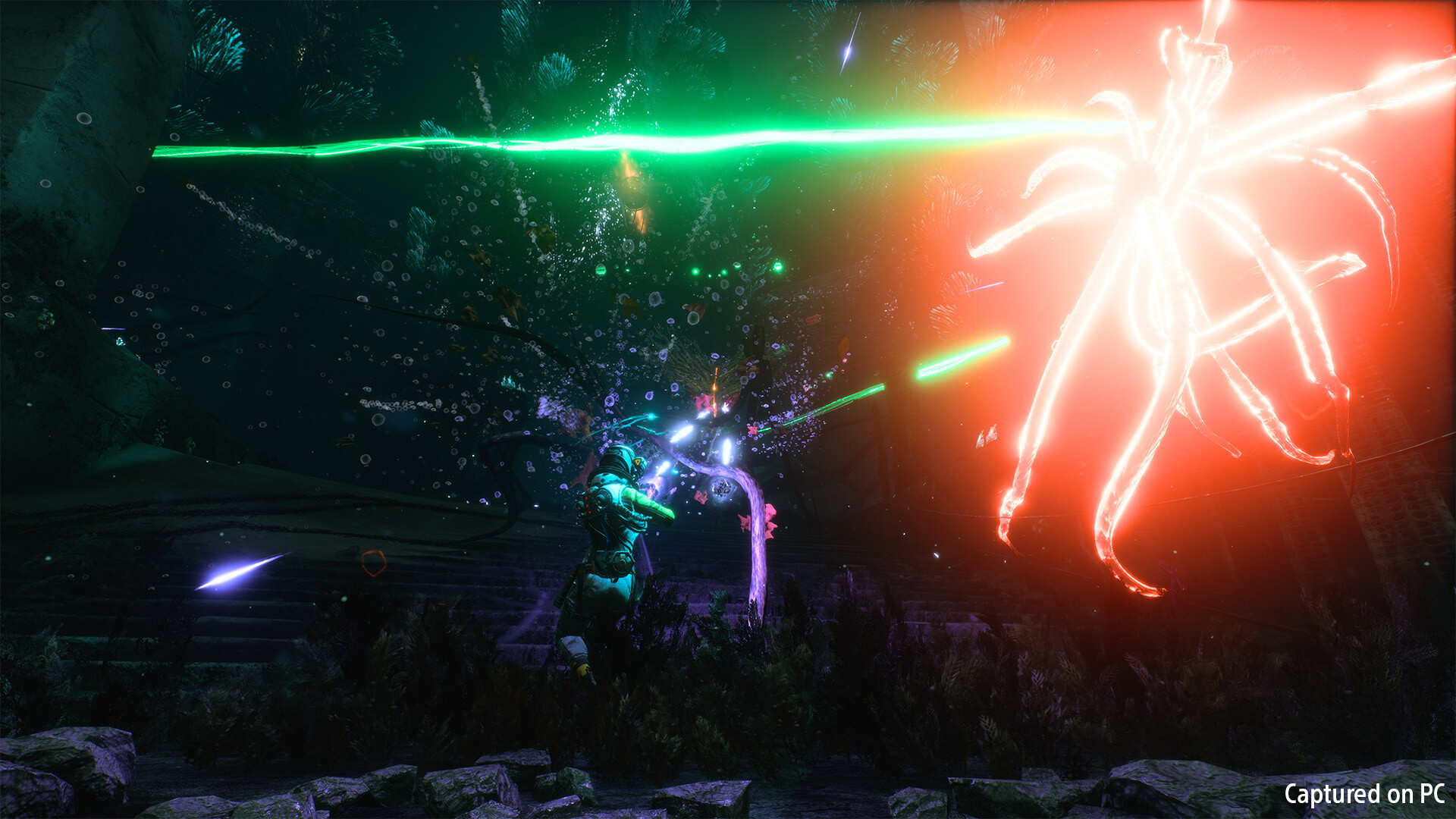
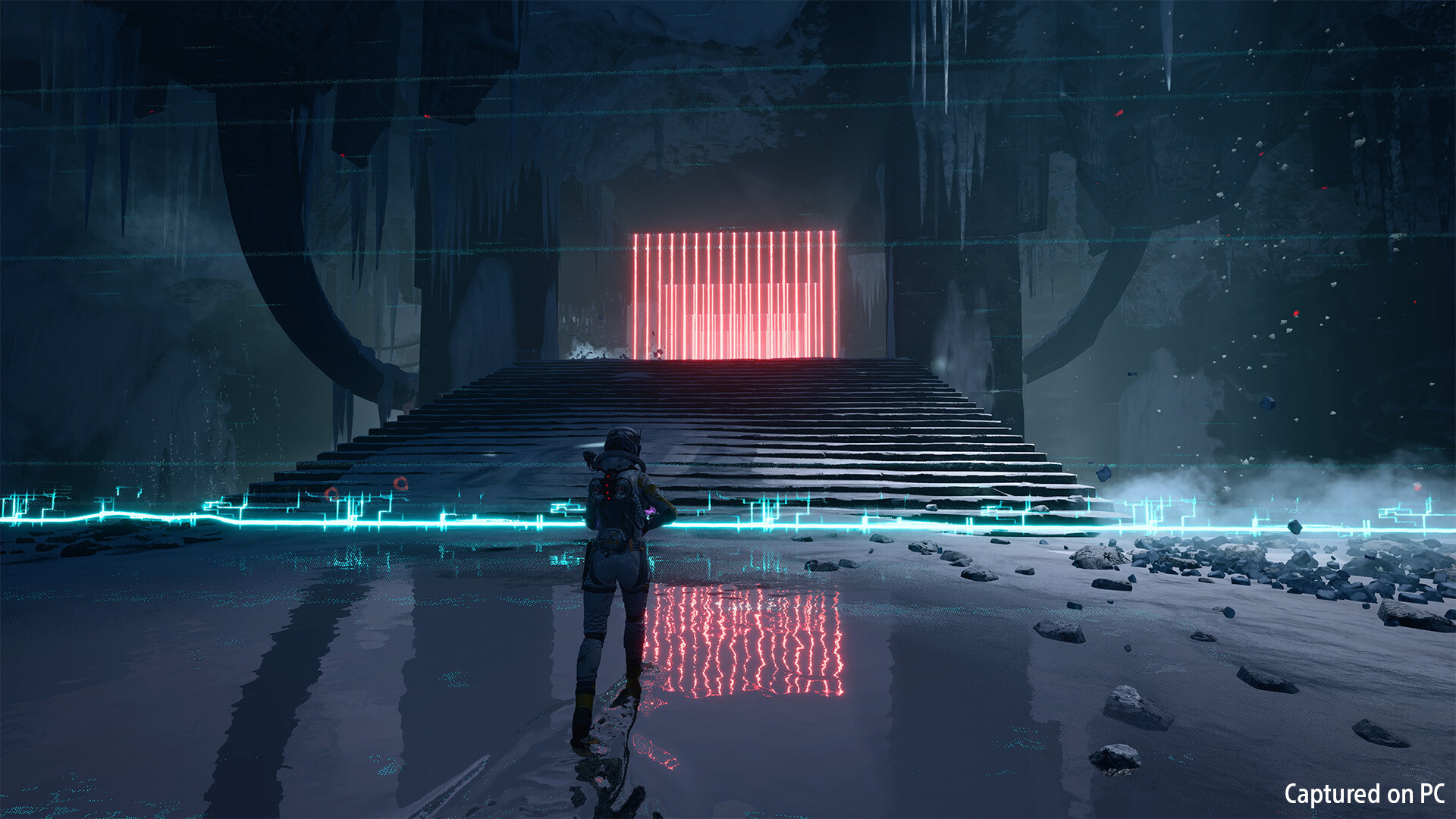
Atropos is an alien world of impossible architecture and biological horror. The planet's surface shifts between runs — corridors rearrange themselves, new rooms appear, old shortcuts vanish — which creates a geography that is always familiar and always slightly wrong. That disorientation is intentional. The world is not random for the sake of variety. It's random because the world itself is hostile to comprehension.
Six major biomes structure the game's progression:
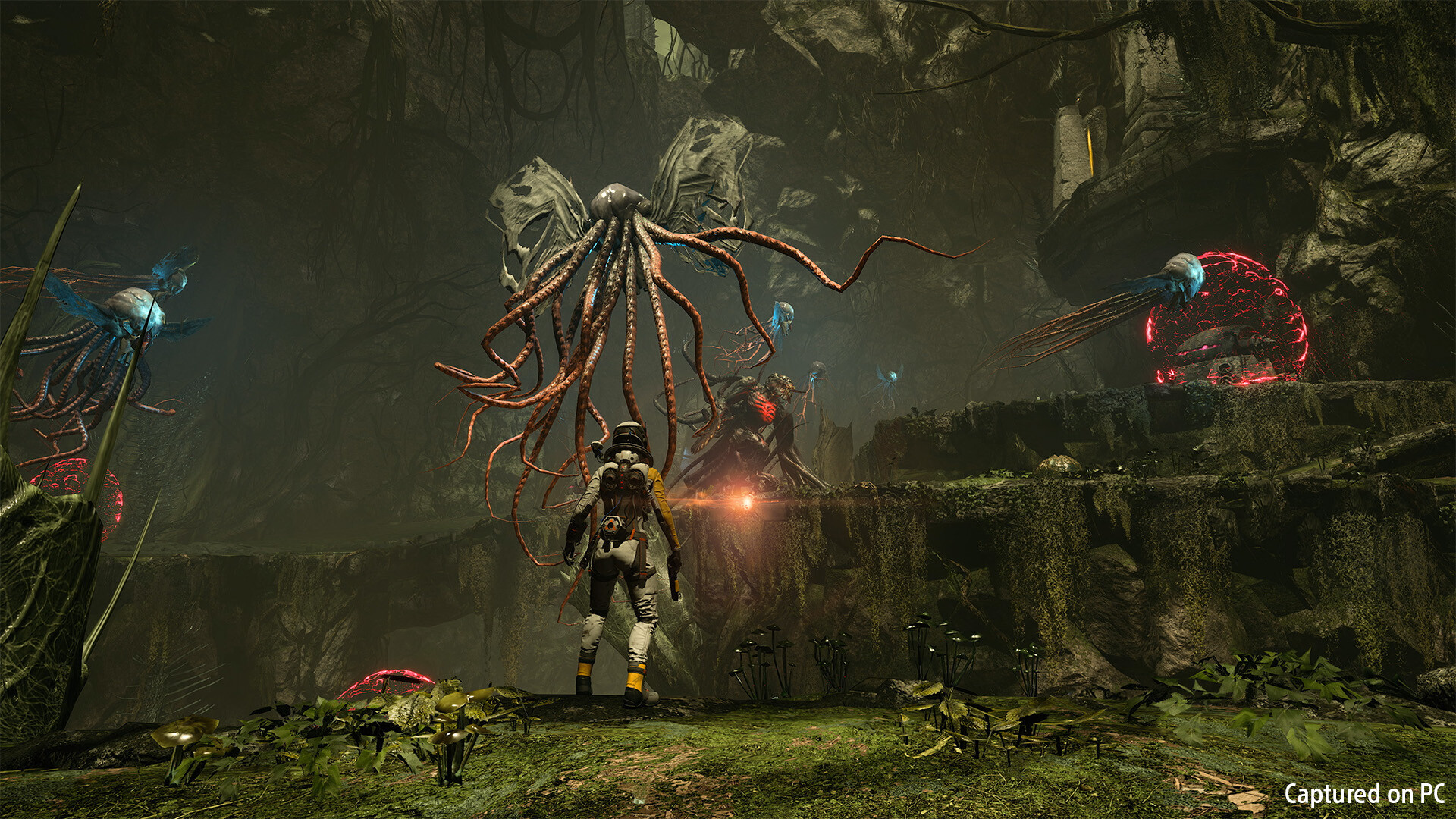
- ▶Overgrown Ruins — the starting biome. Stone corridors choked with alien vegetation, enemies that telegraph attacks with blossoming bullet patterns. The place where you die most, and where you learn the most.
- ▶Crimson Wastes — an open, reddish expanse. Enemy density increases. The architecture becomes more exposed, removing cover and forcing engagements at range.
- ▶Derelict Citadel — oppressive, mechanized, vertical. The biome introduces rotating platforms and environmental hazards that punish hesitation.
- ▶Echoing Ruins — hallucinatory architecture that feels genuinely wrong. Enemy patterns become denser and more synchronized.
- ▶Fractured Wastes — a fragmented, crystalline zone where spatial logic begins to break down. The game's climactic section.
- ▶Abyssal Scar — co-op territory introduced in the Ascension update. A deep-sea zone reached through the Tower of Sisyphus.
Scattered across these biomes are audio logs, environmental echoes, and brief cinematic visions — fragments of a story that only resolve meaning across multiple deaths and discoveries. A house. A woman. A cycle that predates Selene. The lore accumulates slowly and deliberately, and understanding it requires the same patience that surviving the combat requires.
Core Mechanics: A Systems Breakdown
The Cycle of Death and Progression
Returnal does not hold your hand about what it keeps and what it takes when you die. Here is the short version: you lose your weapons, consumables, and temporary stat bonuses. You keep your permanent upgrades (Parasites, Astronaut Figurine, Silphium unlocks), your story progression, and any Ether you've collected.
Ether is the persistent currency. It lets you cleanse Malignant items before picking them up (removing their curse risk), purchase resin upgrades at specific fabricators, and use the Reconstructor — a one-per-run revival station that brings you back at the cost of half your max health. These permanent systems give each run forward momentum even when the run ends in failure, which transforms death from punishment into information.
Weapons and Altfire
Every weapon in Returnal has an Altfire: a secondary ability with a cooldown that is often more powerful than the primary fire mode. The Carbine's Altfire fires a burst of piercing rounds. The Spitmaw Blaster's launches a shotgun blast. The Hollowseeker's creates a portal salvo. Learning the Altfire of whatever weapon you pick up in a given run is often as important as learning its primary behavior.
Weapons are also procedurally generated with trait bonuses — accuracy buffs on hitting dashes, damage bonuses for consecutive hits, status effect riders. Reading a weapon's traits and understanding how they interact with your current build is a skill that deepens over time.
The Dash and Hyperion's Flow State
The dash is Returnal's most essential defensive tool. It grants brief invincibility frames during the animation — enough to pass through bullet streams cleanly if your timing and direction are correct. That "if" is doing a lot of work. The game's bullet patterns are dense enough that reactionary dashing rarely works. Survival requires anticipation: reading the enemy's body language before the shot fires, committing to a dodge angle a half-second early, and trusting the animation to carry you through.
When this clicks — when you're weaving through overlapping bullet spirals, popping Altfire between dashes, managing Malignancy and Parasites and cooldowns simultaneously — Returnal produces a flow state unlike almost anything else in games. The difficulty is not a barrier. It's the point.
Status Effects and Risk/Reward
Picking up items in Returnal often carries malignancy risk. A Malignant weapon curses you: a random negative effect activates until you clear the curse by killing enough enemies. Parasites offer passive bonuses paired with active downsides (a Parasite might grant increased damage but cause your health to drain when not moving). These systems create moment-to-moment decisions with real consequences. A powerful but cursed weapon might be worth carrying into a boss fight. Or it might get you killed. The answer changes based on how far into a run you are, what your current health and build look like, and how comfortable you are with the enemy patterns in the next room.
Moments That Define the Game
Phrike — the first boss — is your baptism. A three-phase encounter that introduces the game's full bullet-pattern vocabulary in concentrated form. Your first victory feels like a negotiated peace with the game's logic rather than a win. It's one of the most memorable first-boss moments in modern gaming precisely because the learning curve is steep enough that the victory feels genuinely earned.
Ixion — the second boss — unfolds in a wide arena where spatial tracking becomes as important as pattern recognition. It's also where the game starts layering its narrative implications, with visual motifs that recur across deaths in ways that demand attention.
The House — recurring through all six biomes as a mysterious location Selene can enter — shifts from eerie to deeply unsettling as the story develops. Walking through the same domestic spaces across dozens of runs and watching them change is one of the more subtle pieces of horror game design in recent memory.
The Tower of Sisyphus — the Ascension update's primary addition — is an endless, escalating challenge mode that drops the narrative pretense entirely and asks: how far can you go? The procedural difficulty scaling is finely tuned, and the Tower functions as an endgame goal that technically has no end. It remains the most replayable content in the game.
Surviving the Loop: Tips for New Arrivals
1. Overworld exploration is mandatory, not optional. Rooms contain consumables, hidden weapons, and lore. Every room you skip is a resource you might need later. Clear thoroughly.
2. Watch the enemy before shooting. Returnal's enemies telegraph their attacks with clear visual signals. Spending the first few seconds of a new enemy encounter observing rather than attacking will teach you more than dying to it will.
3. Ether is your safety net — use it deliberately. Cleansing Malignant items is worth the Ether cost when you're deep into a run. Save at least some for the Reconstructor.
4. Parasites are worth the downside. The stat bonuses Parasites provide are often substantial. Learn which downsides you can manage (health drain when stationary is easy to avoid; automatic weapon swap during combat is not).
5. Understand the Altfire before the boss. Every boss in Returnal has phases where primary fire opportunities are limited and Altfire is essential. Know what your Altfire does before you enter the arena.
6. The house is a break, not a distraction. Entering the house restores a small amount of health and advances the narrative. Always enter if you're below half health before a boss door.
Community Reception: What Players Are Saying
Returnal on Steam carries a Very Positive rating with 87% positive reviews across its full review history. The PC port — maintained by Climax Studios — added quality-of-life improvements including a suspend/resume save system (absent at PS5 launch, which caused significant early controversy), full ultrawide support, and comprehensive PC settings that largely satisfied the platform's audience.
The initial PS5 release generated considerable debate about the save system — or lack thereof. Naughty Dog's original design required players to complete entire runs without pausing, which for the longest sessions could mean hours of engagement without a checkpoint. The PC and updated PS5 versions resolved this with suspend/resume, making the game significantly more approachable without altering its fundamental difficulty.
Metacritic score: 86 (PC) — consistent across both platforms, with critics praising the combat system, atmosphere, and narrative ambition while noting (reasonably) that the roguelike difficulty curve is not for everyone.
The game has maintained an active community around speedrunning and Tower of Sisyphus score optimization. Discussion boards remain active with build theorycrafting and lore analysis. The Returnal subreddit still processes a steady stream of players reaching endgame milestones for the first time.
Why This is a GamePeak Pick
GamePeak Picks recognizes games where the question "have you played this?" functions as a genuine conversation. Returnal qualifies on every count.
It is technically singular — no other game on PC or console combines third-person spatial shooting with 2D bullet-hell density at this fidelity and this pace. It is narratively ambitious in ways that most action games don't attempt. And it delivers a specific experiential payoff — the flow state of mastering a system that initially seems impossible — that almost no other game replicates.
The barrier is real. If your patience for failure is limited, Returnal will frustrate you. But if you're willing to treat each death as data and each successful run as progress, the game rewards that investment with something few titles can offer: the specific satisfaction of becoming good at something genuinely difficult, in a world that is extraordinary to be inside.
The 2023 PC release made this experience accessible to more players than ever. There is no better time to make the loop.
Final Verdict
“Returnal is the closest games have come to making difficulty feel like art. Every death is a lesson, every run is a new sentence in an alien language you're gradually learning to read. Housemarque didn't just make a great roguelike — they made a great game, full stop. An essential GamePeak Pick.