Editor's note: this article summarizes published reviews, store data and community reception. GamePeak did not run its own playtest, so no GamePeak score is given.

# Resident Evil 4 Remake — A Perfect Remake of a Perfect Game
The Hardest Assignment in Gaming
Remaking Resident Evil 4 is one of the most difficult tasks a game studio can take on. The original 2005 game didn't just succeed — it redefined the action-game genre. Over-the-shoulder third-person perspective. Context-sensitive actions. Resource management inside frantic combat. The language that most action games still speak today was written in that village in rural Spain, by Leon S. Kennedy, with a shotgun in one hand and an attaché case full of herbs and ammo in the other.
How do you improve a game that invented the template? Capcom's answer, delivered on March 24, 2023, was meticulous, confident, and brilliant. The 2023 remake doesn't replace the original — it elevates it.
What Capcom Was Working With
The original Resident Evil 4 was released in January 2005, first on GameCube, then PlayStation 2 and beyond. It was directed by Shinji Mikami and represented a radical departure from the series' fixed-camera survival horror roots. By giving the player direct over-the-shoulder control of Leon and introducing enemies who used real tactical behavior — flanking, throwing weapons, calling for backup — Mikami effectively invented a new genre template.
The game became one of the most critically acclaimed releases of its decade. It sold millions of copies across multiple platforms and ports, inspired an entire lineage of action games including the Gears of War series, and remains playable and satisfying today in its original form.
Capcom remade Resident Evil 2 in 2019 and Resident Evil 3 in 2020. Both were accomplished reimaginings, and the RE2 Remake in particular was universally lauded. RE4's turn was more daunting. Unlike 2 and 3, the original RE4 had aged exceptionally well. It didn't need rescue — it needed elevation.
That's a harder job. Capcom did it anyway.
The Village Has Never Looked Like This
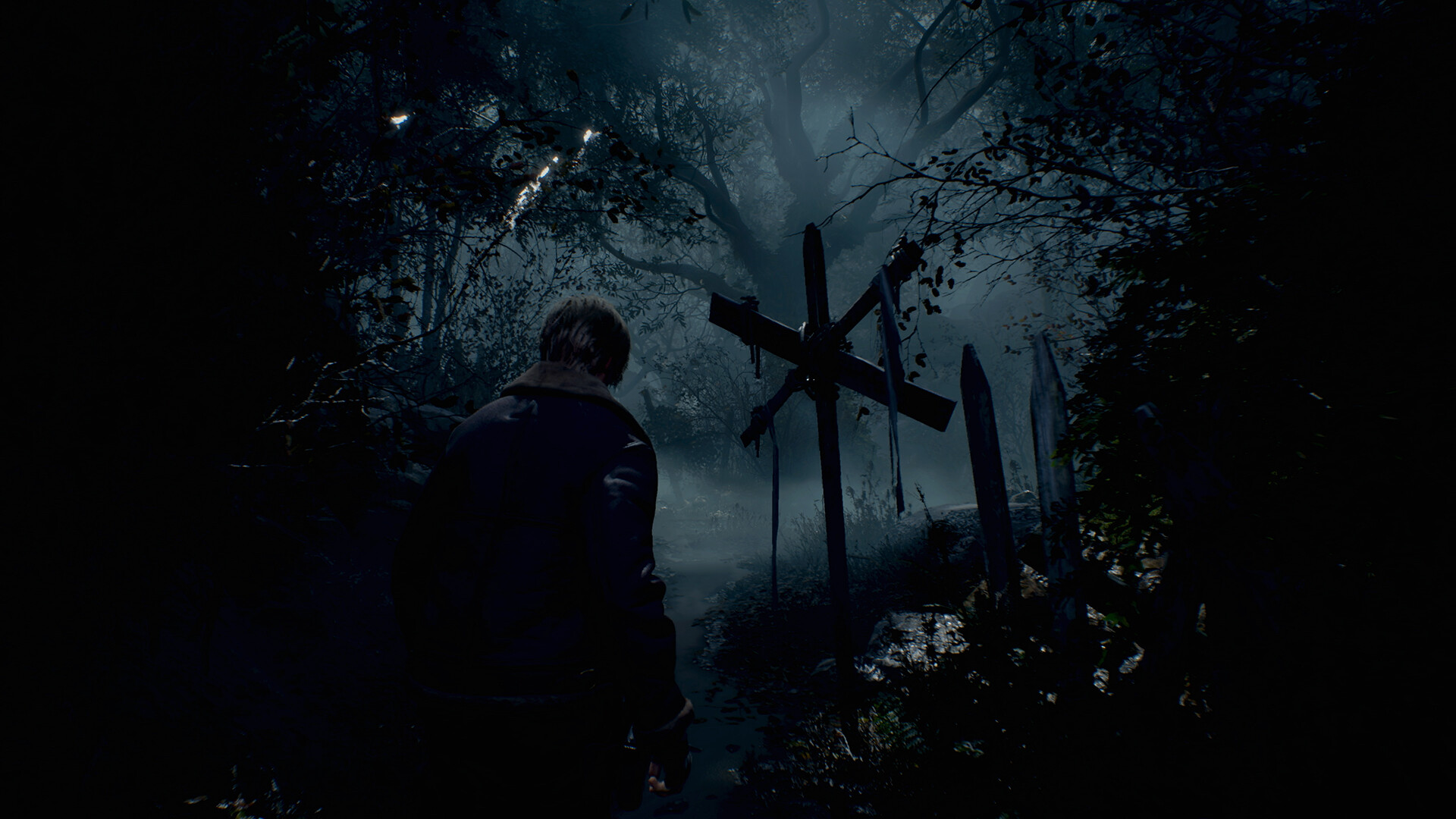
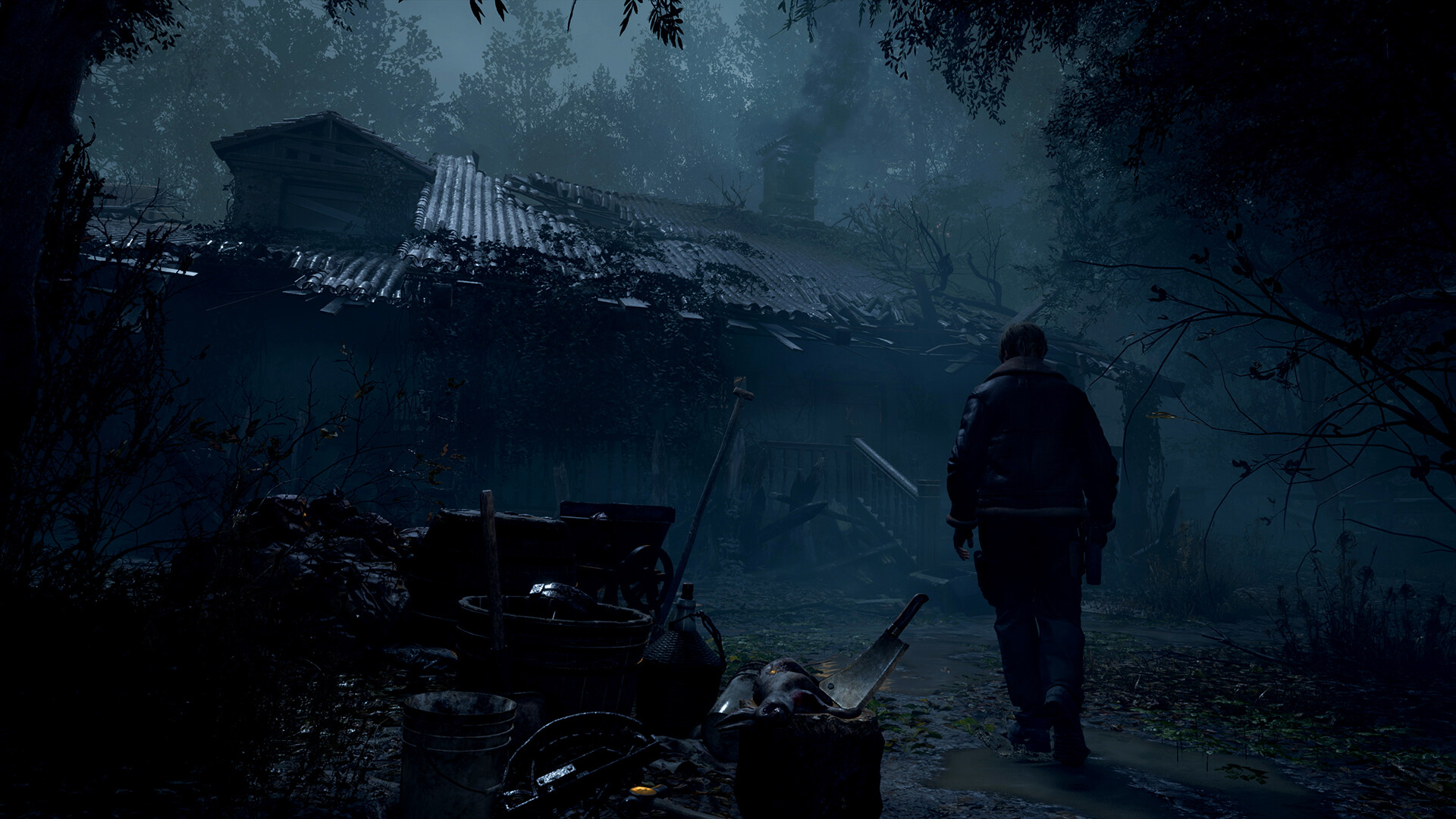
The visual overhaul from the original to the remake is extraordinary. The RE Engine — Capcom's proprietary rendering technology, also responsible for the RE2/3 remakes, Devil May Cry 5, and Monster Hunter Rise — produces an environment of exceptional visual quality. The Spanish village where Leon arrives is rendered in grey-green winter light, with mud underfoot, smoke rising from chimneys, and chickens wandering paths that are about to become combat zones.
Every location from the original is reimagined with this fidelity: the lake, the castle's grand halls and underground labs, the island's industrial interiors. The remake isn't just prettier — it uses visual design to create atmosphere that the original, for all its strengths, couldn't achieve on 2005 hardware.
The enemy designs are particularly effective. Ganados — the infected villagers — have the glazed, wrong-eyed look of people whose minds have been colonized. The Illuminados cult members who serve Saddler carry real menace. The El Gigante bosses are enormous in a way that registers physically. Dr. Salvador, the chainsaw-wielding maniac who became iconic in 2005, is terrifying in the remake in a way that transcends the comedy of the original encounter.
Core Gameplay: The Over-the-Shoulder Template, Perfected
Movement and Combat Feel
The 2023 remake gives Leon significantly more mobility than the original allowed. The most significant addition is the ability to move and shoot simultaneously — the original RE4 required players to plant their feet before aiming, creating a tension between positioning and aggression that was a deliberate design choice. The remake's Leon can back-pedal while firing, sidestep, and engage enemies while in motion.
This sounds like it might simplify things. It doesn't. The remake compensates with more aggressive enemy behavior, tighter ammo economy, and combat scenarios designed specifically around the new mobility. The result is an action system that feels both more modern and more demanding than its predecessor.
Parrying is a new addition — a perfectly-timed button press deflects melee attacks and some thrown projectiles. Mastering the parry is optional on normal difficulty but becomes essential on Professional mode, where resources are scarce enough that avoiding hits is an economic necessity.
Resource Management: The Attaché Case Returns
The attaché case inventory system — one of the original's defining mechanics — returns intact and improved. Leon's case has a finite grid of space. Every item, weapon, healing herb, and grenade takes up physical space in that grid. Managing the case, deciding what to carry and what to leave, is a constant low-stakes puzzle that runs through the entire game.
The upgrade system for weapons is equally satisfying. Firepower, reload speed, capacity, and exclusive upgrades (unlocked at max level for each weapon) can all be purchased from the Merchant using Pesetas collected throughout the game. Choosing which weapon to invest in — and deciding whether to sell an underperformer for funds — creates genuine engagement with the economy.
The Knife: From Tool to System
The biggest mechanical expansion in the remake is the knife. In the original, Leon's knife was a last-resort weapon with limited utility. In the remake, it is a fully-fledged combat tool with its own durability meter.
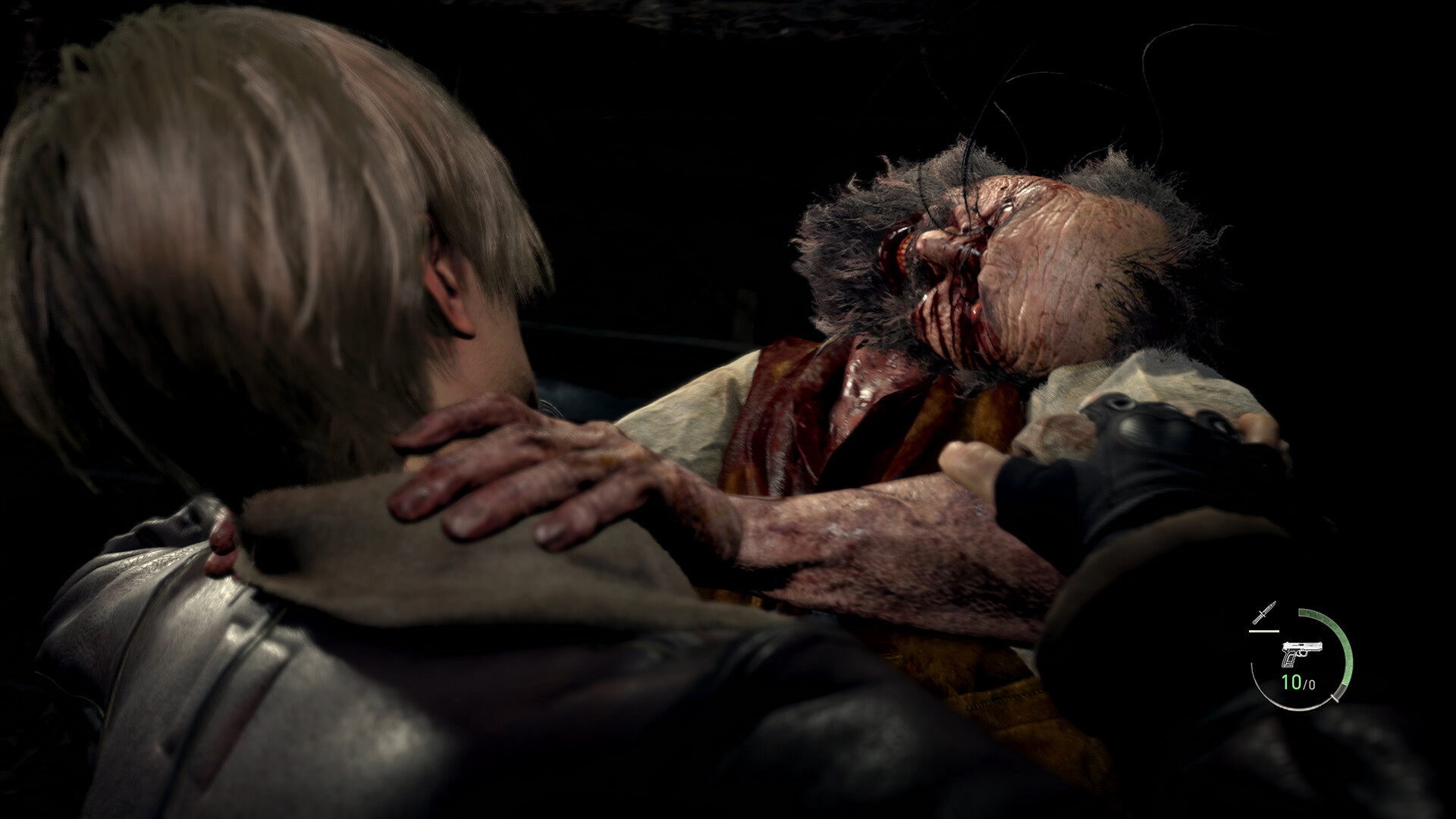
The knife can stealth-kill unaware enemies. It can parry incoming attacks. It can interrupt a Ganado mid-grab, saving Leon from a neck-bite. When Leon is pinned or grabbed, mashing the action button uses the knife as an escape tool. The knife wears down with use and must be repaired at the Merchant — which costs resources, creating a management decision about when to use it freely and when to conserve.
A fully upgraded knife is among the strongest weapons in the game. Getting there requires sustained investment. The knife system is the remake's finest original contribution to the RE4 formula.
The Merchant: Still the Best NPC in the Series
"Stranger, huh? Got some stuff, might interest ya." Voiced and redesigned but spiritually identical to his original incarnation, the Merchant returns at regular waypoints throughout the game to buy, sell, and upgrade. His casual warmth in the middle of a nightmare scenario is as charming as it ever was. The Spinels economy — rare items found by completing blue-note side requests — gives players additional purchasing power for exclusive items and recipe cards. Finding his shop behind a hidden bookshelf never gets old.
The Story Expanded
The original RE4's story was brisk and self-aware — a kinetic action narrative that wore its B-movie sensibilities as a badge. The remake expands the story significantly, adding emotional depth without losing the momentum.
Leon S. Kennedy, six years after the events of Raccoon City (as depicted in Resident Evil 2), is assigned to recover Ashley Graham — the U.S. President's daughter — from a religious cult called Los Illuminados in rural Spain. The cult is led by Osmund Saddler, who uses a mind-controlling parasite called the Plaga to maintain control over the local population and his soldiers.
The remake deepens Leon's characterization considerably. His trauma from Raccoon City is present — his relationship with his handler Ingrid Hunnigan and his conversations with Ada Wong carry weight that the original didn't reach for. Ashley, often criticized in the original for passive gameplay sections, is given more agency and more personality. The dynamic between Leon and Luis Sera — a Spanish researcher with inside knowledge of the Plaga — is expanded into one of the game's genuine highlights.
The remake also adds new story content that bridges earlier games in the series and contextualizes Saddler's operation more thoroughly. Returning players will find new scenes and revelations. First-timers will encounter a cohesive, well-paced narrative that earns its emotional beats.
Moments That Define the Remake
The Village Battle — the first major combat encounter, where Leon defends a house while dozens of Ganados converge from all directions — arrives early and establishes the game's combat language completely. Using the environment, managing doors and windows, handling crowd control without burning all your ammo: it teaches by doing, without a tutorial in sight.
Bitores Mendez — the hulking village chief — is the first boss encounter that uses the knife system to full effect. His fights demand situational awareness and resource discipline in a way that sets the template for what's coming.
The Lake — a sequence involving a lake monster and a motorboat that pays tribute to the original while using the remake's physics and visual fidelity to remake the encounter as something genuinely cinematic.
Salazar's Castle — the game's second act — is the remake at its most expansive. The castle spans multiple wings, contains the game's most varied enemy encounters, and delivers the Salazar boss fight as a spectacular multi-stage showpiece.
Krauser — the knife duel with a former comrade of Leon's is the game's most memorable one-on-one encounter. In the remake, it's a tense, knife-focused duel that makes the expanded knife system feel like it was designed precisely for this moment.
The Numbers Don't Lie
Resident Evil 4's Steam rating is Overwhelmingly Positive at 97% — one of the highest scores any major release has achieved on the platform. At time of publication it represents tens of thousands of reviews, and the positivity has remained consistent since launch.
The Metacritic score is 93 — one of the highest-rated games of 2023 and among the highest-rated Capcom has ever received. Critics consistently praised the combat depth, the atmosphere, and Capcom's restraint in knowing what to preserve versus what to expand.
Sales exceeded 7 million copies in the period following launch, outpacing Capcom's initial projections and cementing it as one of their best-selling titles.
Community reception has been overwhelmingly warm from a demographic that included both returning fans of the 2005 original and new players encountering the story for the first time. Forum discussions frequently focus on Merchant interactions, knife system mastery, and Separate Ways — the DLC campaign following Ada Wong that adds significant story context. The Professional difficulty mode has spawned an active speedrunning and challenge community. New Game+ keeps experienced players returning.
Tips for New Players
- 1Do not ignore blue note requests. These optional tasks from the Merchant reward Spinels, which unlock exclusive items and weapon upgrades not available through standard currency. Missing them means missing meaningful upgrades.
- 1Upgrade the Shotgun or Striker early. Crowd control is essential in the castle sections. A high-power shotgun blast into a crowd of Ganados is efficient ammo economy compared to picking them off individually.
- 1Use the knife deliberately. Don't spam it — parry with it when an attack is telegraphed, use stealth kills when available, and let it rest when your durability is low. A broken knife mid-boss is a liability.
- 1Shoot legs, then stomp. Shooting a Ganado in the legs staggers them to their knees — which opens a melee execution prompt (a kick or roundhouse). These staggers are the foundation of efficient crowd management.
- 1Explore every corner of the castle. The second act is where the game is most generous with hidden rooms, treasures, and Merchant interactions. Rushing the main path skips significant upgrade resources.
- 1Play Separate Ways after finishing the main campaign. This DLC adds Ada Wong's perspective on the same events and is substantial enough to be treated as a second playthrough. It's excellent.
Why This is a GamePeak Pick
The 2023 Resident Evil 4 is on this list for the same reason the original 2005 game would be on a list like this: it is among the finest examples of its genre. The mechanics are layered and rewarding. The atmosphere is impeccable. The pacing — across roughly 15-20 hours — almost never falters.
But the remake earns its place on its own terms. It is not a nostalgic retread. It is a confident, well-considered reimagining that asked what the original would be if built today, answered that question with exceptional craft, and delivered a game that stands alongside — not merely in the shadow of — one of the most beloved titles in gaming history.
Overwhelmingly Positive at 97% on Steam. Metacritic 93. 7 million copies sold. The verdict from critics, players, and the market was unified: Capcom delivered.
Final Verdict
“Resident Evil 4 Remake is a masterwork. It demonstrates that the highest ambition for a remake is not to preserve a classic but to let a new generation of developers express what that classic means to them — and to make something extraordinary in the process. Leon S. Kennedy has never been better company. An unqualified GamePeak Pick.