Editor's note: this article summarizes published reviews, store data and community reception. GamePeak did not run its own playtest, so no GamePeak score is given.
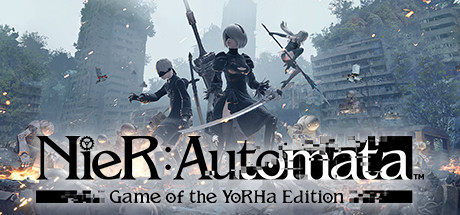
# Nier: Automata — The Game That Proved Games Can Be Philosophy
Steam Rating: Very Positive (93%) | Metacritic: 88 | Sales: 7 million+ copies
“Community Reception: Steam reviews are dominated by two sentiments: "I sat in silence after Ending E" and "I didn't know games could do this." The community is almost evangelical about Route completion — newcomers who try to stop at Route A are quickly redirected by every forum thread they'll encounter. The game's philosophical depth generates genuine discussion years after launch, not just nostalgia.
A Game That Asks "What Is the Point of Existence" — and Answers Through Gameplay
Many games have tried to engage with philosophy. Most fail in the same way: they put philosophical dialogue into cutscenes, let characters debate meaning over still camera shots, and then return you to combat that has nothing to do with any of it. Nier: Automata refuses that approach entirely.
This game doesn't talk about existentialism. It makes you live inside it.
Released in 2017, Nier: Automata combines director Yoko Taro's dark, cyclical worldbuilding with PlatinumGames' razor-sharp action mechanics. It scored an 88 on Metacritic, earned "Overwhelmingly Positive" on Steam, and has sold over seven million copies worldwide. But the numbers barely capture what makes this game significant.
Nier: Automata is one of the most daring things anyone has ever made in the medium. It asks what games are capable of — and then answers by doing exactly that.
The Combat: PlatinumGames Action Meets Yoko Taro's World
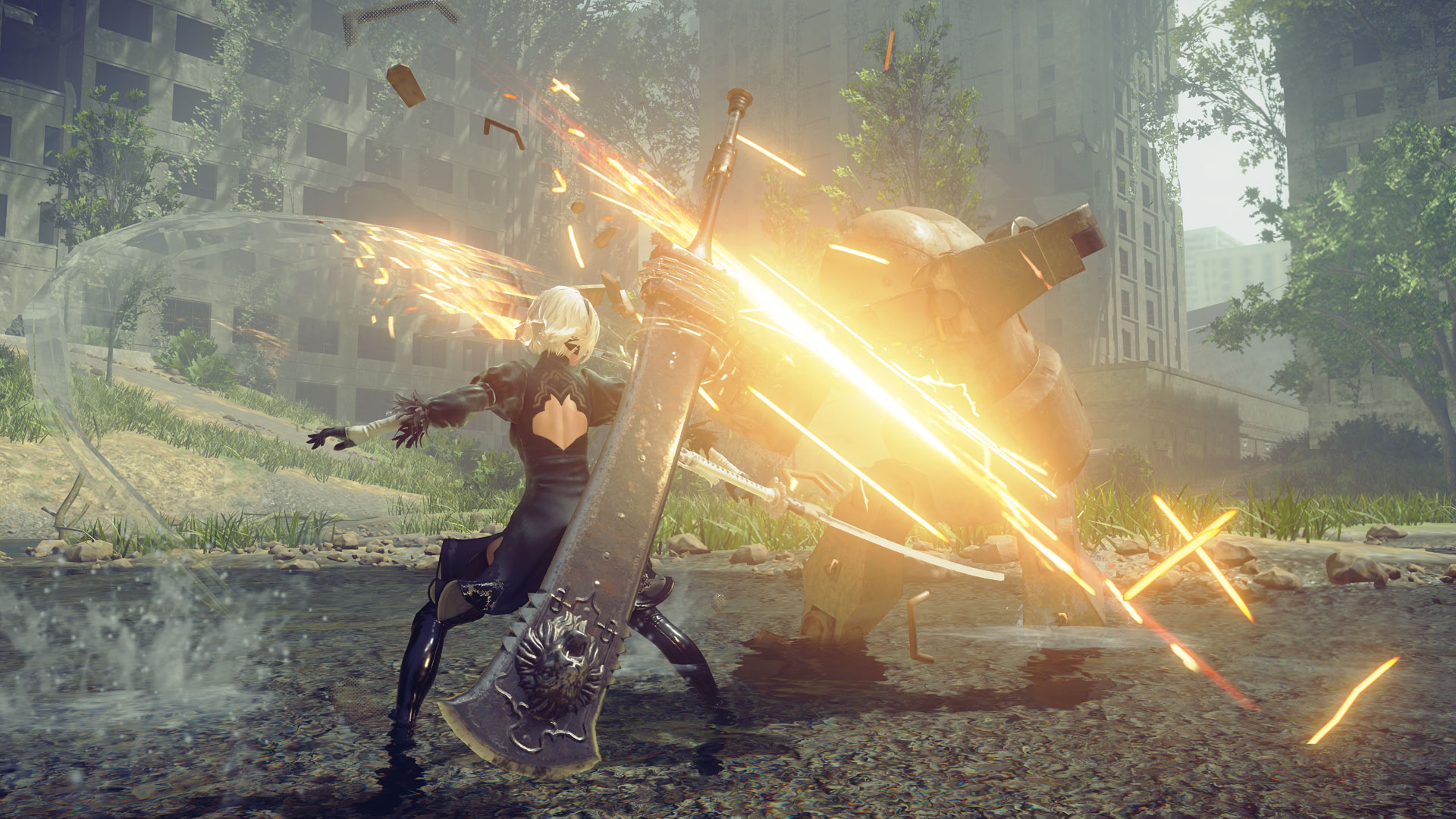
PlatinumGames has a reputation — Bayonetta, Metal Gear Rising: Revengeance, Vanquish — and Nier: Automata represents their craft operating at its highest level within a single game.
The core combat system is built around two weapon slots and fluid aerial and ground combo chains. Button-mashing produces competent results; developing actual skill with dodge timing, attribute matchups, and combo routing unlocks something far more expressive. A well-timed evasion activates a brief slow-motion window (via the "Overclock" chip), creating a counterattack opportunity that rewards attention over reflexes.
What makes the combat remarkable, though, is what surrounds it. Nier: Automata shifts genre without warning. A standard third-person action sequence transitions into a twin-stick bullet-hell shooter mid-boss. A corridor becomes a side-scrolling platformer. A late-game encounter turns into something that defies easy genre classification. These transitions aren't style for its own sake — each one carries narrative weight. Yoko Taro uses form as content, and the genre shifts are part of what the game is saying.
The Pod System and Weapon Variety
Every playable character in Nier: Automata is accompanied by a Pod — a small combat drone that provides continuous ranged support and activates powerful special attacks called Pod Programs. Programs include laser beams, missile barrages, gravity fields, and wide-area detonations, each with a cooldown that demands strategic timing rather than spam.
Weapon variety is substantial. Melee categories include small swords (fast combos), large swords (heavy impact), spears (range and sweep), and combat bracers (extremely fast, short reach). Equipping different weapon types in each slot creates distinct combo architectures — a small sword into a large sword creates a natural rhythm of fast opener into heavy finisher, while bracers reward aggressive close-range play.
Weapons level up through use and can be upgraded with crafting materials found in the world. The system encourages experimentation. You'll likely find a combination that fits your instincts within the first few hours, and refine it from there.
The YoRHa Androids: 2B, 9S, A2 — Why Each Plays Differently
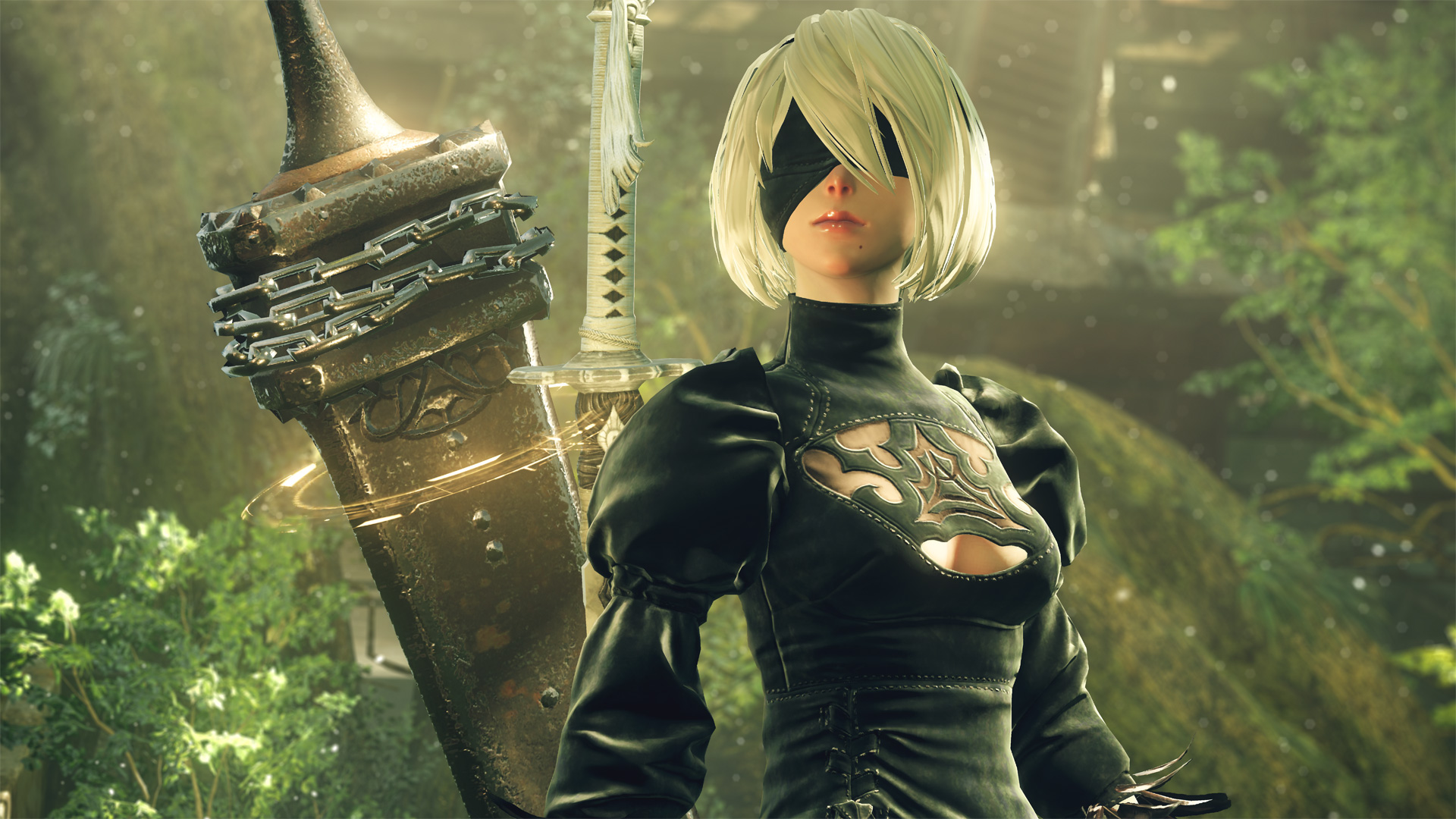
Nier: Automata gives you three playable characters across its routes, and the differences in how they play are not superficial.
2B (YoRHa No.2 Type B) is the game's primary protagonist and the character you spend the most time with. A combat-type android, she handles beautifully — full weapon slot flexibility, excellent aerial mobility, and the cleanest expression of PlatinumGames' combat design. She is programmed to suppress her emotions. What lies beneath that suppression is the question the game builds toward.
9S (YoRHa No.9 Type S) is a scanner-type android. His offensive capabilities are reduced compared to 2B, but he has a hacking ability that opens a different kind of engagement. Successful hacks trigger a brief minigame and allow him to control enemies, trigger explosions, or drain resources. Playing as 9S is a more cerebral experience — and his perspective on the exact same events 2B witnesses reveals a fundamentally different picture of the world. His curiosity, emotional sensitivity, and gradual unraveling form one of the game's most affecting character arcs.
A2 (YoRHa Type A No.2) is a prototype android who went rogue — a predecessor to the YoRHa line. She plays similarly to 2B but with a Berserk ability that temporarily amplifies attack power at the cost of sustained HP drain. A2 moves through the game like someone who has already processed everything 2B and 9S are still discovering. Her existence is the key to understanding what the world is actually built on.
The decision to give each character a distinct mechanical identity rather than reskinning one set of controls is what makes the structure of the game's routes feel earned.
Multiple Playthroughs — Routes A/B/C: Why You Must Play All of Them
Finishing Nier: Automata once and moving on is the single most common mistake players make with this game.
The game is structured around multiple routes. Route A follows 2B through the main narrative. It ends. It feels complete. It isn't.
Route B replays the same sequence of events from 9S's perspective. If this sounds like it would feel repetitive, it doesn't. 9S's hacking abilities change how combat plays. More importantly, the things 9S hears, sees, and processes during those same events expose layers of the story that were invisible from 2B's vantage point. Route B reframes everything. By its end, the game you thought you understood looks different.
Route C and beyond is where Nier: Automata makes its most audacious move. Without spoilers: the game begins to comment on itself and on the act of playing it. The structure, the player's relationship to the characters, and the concept of save data all become part of what the game is saying. Route C is where the philosophical undertow of the first two routes becomes the current.
Do not look up what happens. Play in order. Do not skip. This is non-negotiable.
The World: Post-Apocalyptic Earth Abandoned by Humans, Ruled by Machines
The setting is Earth, thousands of years in the future. Alien-created Machine Lifeforms invaded and overran the planet. Humanity retreated to the moon, directing the android army YoRHa to fight a proxy war to reclaim the surface. You explore that surface as a YoRHa unit.
The world is strange and beautiful in a way that's hard to describe before you've seen it. In an abandoned theme park, Machine Lifeforms dance in looping circles where children once rode carousels. In the desert, enormous sand sculptures stand without apparent author or purpose. In the ruins of an aquatic habitat, machines wearing fisherman hats try to understand what fishing meant to the humans they've never met. The environments don't read as empty postapocalyptic backdrops — they read as a civilization of machines attempting, imperfectly and desperately, to understand what humanity was.
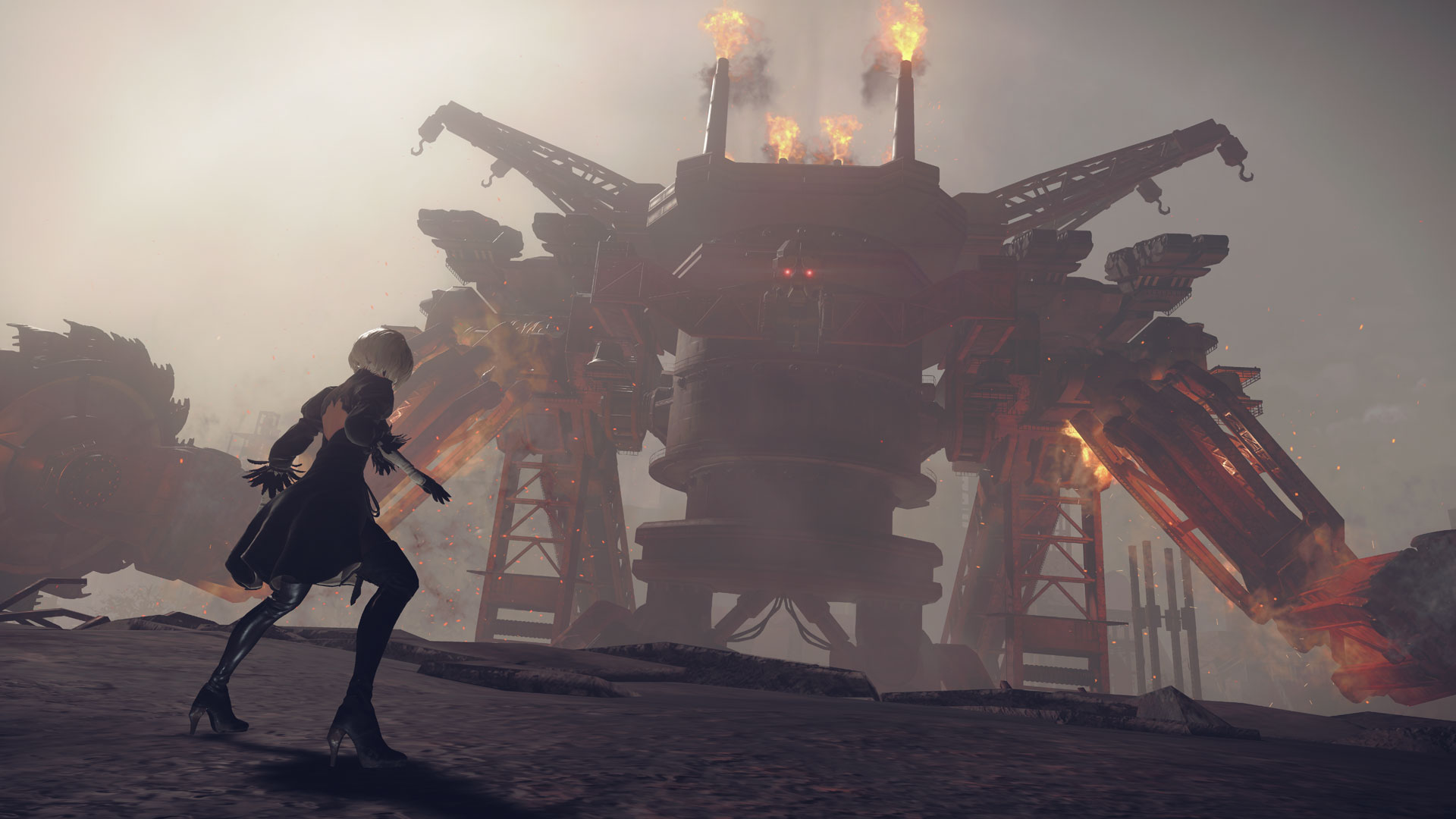
Explorable zones include the flooded ruins of a city, a desert region, a forest zone, a collapsed factory complex, the theme park, and a lunar base. Each carries its own atmosphere and its own network of sidequests. The world is not enormous by open-world standards, but every corner of it has something worth finding.
Philosophy Embedded in Gameplay: The Sidequests That Are Really Moral Thought Experiments
The sidequests in Nier: Automata are not fetch quests in philosophical clothing. They are genuinely constructed thought experiments that happen to have quest markers.
One quest involves a community of Machine Lifeforms who have renounced violence and declared themselves pacifists. What does an android soldier — programmed to destroy machines — do when confronted with machines that no longer want to fight? Another quest involves a machine that has been studying human culture and wants to understand what love is. A different one places two characters in direct conflict over whether an android's emotions are "real" if they originate from programming. Several require choices that have actual consequences and no clearly correct answer.
The game references Nietzsche, Sartre, and Camus by name. Characters debate the nature of identity, the value of memory, the ethics of war as purpose versus means. But Nier: Automata is not a philosophy textbook. It does something far more effective: it makes you act within these questions. Your choices don't just determine quest outcomes — they determine your own position on the questions being posed. That is something no novel or film can replicate.
Do not skip the sidequests.
The Soundtrack: Keiichi Okabe's Score and Why It's One of Gaming's Greatest
No discussion of Nier: Automata is complete without the music. Composer Keiichi Okabe and his team produced an original soundtrack that frequently tops lists of the greatest video game scores ever created — and that reputation is entirely deserved.
The music in Nier: Automata is dynamic in ways that most soundtracks aren't. Combat tracks layer in choral vocals as intensity increases and strip them back during quieter phases of a fight. Exploration themes and battle themes share melodic DNA, so transitions feel organic rather than jarring. The same motif appears across dozens of tracks in different emotional registers — peaceful, desperate, triumphant, broken — building a musical language that the game uses like a second narrative layer.
Key tracks:
- ▶Weight of the World — The ending theme. Exists in multiple language versions. What it means to a player who has finished the game is something different from what it means to hear it in isolation.
- ▶Copied City — A haunting, minimal track for a location that earns every second of its atmosphere.
- ▶Alien Manifestation — The first major boss encounter. Unease and grandeur simultaneously.
- ▶A Beautiful Song — Deceptively simple. What it accompanies transforms it completely.
The OST won multiple awards and is worth listening to independent of the game. But listening to it after finishing Nier: Automata is a different experience altogether — every track becomes a memory.
The Endings (All 26 of Them): On Ending E
Nier: Automata has 26 endings, labeled A through Z. Most are conditional outcomes triggered by specific decisions or actions — closer to alternate game-overs than true narrative conclusions. They range from darkly comic to quietly devastating.
The endings that matter are C, D, and E.
Endings C and D occur at the conclusion of Route C, branching from a single choice. Both are emotionally complete resolutions to the game's central conflicts. Both are worth experiencing; one follows from the other on a second Route C run.
Ending E begins after the story is over. Describing what it does would be a disservice to anyone who hasn't experienced it. What can be said is this: Ending E is the moment where Nier: Automata uses the medium of video games — specifically, the things only a video game can do — to say something that could not be said in any other form. It is the most frequently cited reason players call this game a masterpiece. It is also the reason this article will not explain it further.
Get there. It is worth every minute of the routes that precede it.
Why It Belongs in Picks: How It Changed What Players Expect from Video Game Storytelling
GamePeak Picks isn't a ranked list of high-scoring games. It's a selection of titles where "have you played this?" functions as a cultural reference point — games that shift the baseline of what players expect the medium to be capable of.
Nier: Automata qualifies on that standard more clearly than almost anything released in the last decade. Since 2017, its influence is visible in how developers approach narrative structure, in how players articulate what they want from game storytelling, in every conversation about whether games can be art. It didn't just raise the bar — it changed what the bar is measuring.
The Steam reviews remain "Overwhelmingly Positive" in 2026. New players find the game every season. Communities still debate its philosophy, still parse its lore, still share the moment Ending E landed on them. That is not nostalgia. That is a game that continues to do its work.
If you haven't played it, there is no better time than now.
Tips Before You Start
Don't skip the sidequests. This cannot be repeated enough. Many of the game's most memorable moments — and some of its most philosophically essential scenes — exist only in the optional content. The game is shorter than it should be if you skip them.
Play on Normal. Easy difficulty simplifies combat to the point of removing most of the engagement PlatinumGames built into the system. Hard difficulty or above is rewarding but better suited to subsequent playthroughs once you know the mechanics. Normal is the intended experience.
The fishing sidequest is worth it. Yes, there's fishing. Yes, it's worth it. The tonal whiplash of fishing in a post-apocalyptic wasteland while existential dread accumulates in the background is entirely deliberate, and the sidequest that grows from it is one of the most affecting in the game.
Customize your chips early. The OS Chip system lets you assign passive abilities — auto-item use, auto-evade, attack optimization — to available memory slots. Spending thirty minutes early in the game configuring this to your playstyle makes everything that follows smoother.
Let the game surprise you. Resist the urge to look things up. Nier: Automata is a game where being surprised is part of the experience. The moments it reserves for players who come in without foreknowledge are among the best in gaming.
Final Verdict
“Nier: Automata asks what androids fight for in a world without purpose. It asks what you fight for. By the time it's done, it may have answered both questions in a way you didn't expect. An unqualified GamePeak Pick — one of the most important games ever made.