Editor's note: this article summarizes published reviews, store data and community reception. GamePeak did not run its own playtest, so no GamePeak score is given.
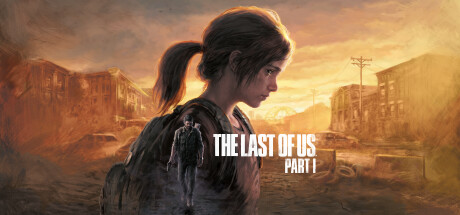
# The Last of Us Part I — The Definitive Version of a Generation-Defining Story
Why The Last of Us Still Matters
In June 2013, Naughty Dog released a game on a console near the end of its lifespan and made a substantial portion of the industry reconsider what games could do with story, character, and emotional weight. The Last of Us sold over 20 million copies across its original PS3 and PS4 remastered versions. It won over 200 Game of the Year awards. It inspired a critically acclaimed HBO television adaptation. A decade later, it is still cited as a benchmark for narrative game design.
The Last of Us Part I — released for PS5 in 2022 and PC in March 2023 — is not a remaster. It is a full remake built from the ground up on modern hardware, with rebuilt character models, redesigned AI behavior, a complete visual overhaul, and a substantial suite of accessibility features. The story and structure are preserved. The fidelity is transformed.
If you've never played the original, this is the definitive version to start with. If you played the original in 2013 or 2014, this is a compelling reason to return.
Background: From PS3 Original to Ground-Up Remake
Naughty Dog's original The Last of Us was built on the PS3 engine that powered the Uncharted series and pushed that hardware to its limits. The 2014 PS4 Remaster improved resolution and frame rate and remains excellent. But The Last of Us Part I represents a different kind of revisitation.
The PS5 and PC rebuild allowed Naughty Dog to reconstruct character faces and animations using the same performance capture and rendering pipeline as The Last of Us Part II (2020), creating visual continuity between the two games. Joel and Ellie now look and move like they belong in the same world as Abby and Dina — characters created four years later with more advanced technology.
The rebuild also significantly enhanced the AI. Human enemies now flank more dynamically, communicate tactically with each other, and respond to player behavior in ways that feel more reactive and less scripted than the original. Infected enemies follow the same improvement curve. The game is meaningfully more challenging and more immersive without altering a single beat of the original design.
Iron Galaxy assisted with the PC port, and while the launch in March 2023 had performance issues that generated negative coverage, subsequent patches addressed the majority of problems. The current state of the PC version is stable and well-optimized for a wide hardware range.
The World of the Outbreak
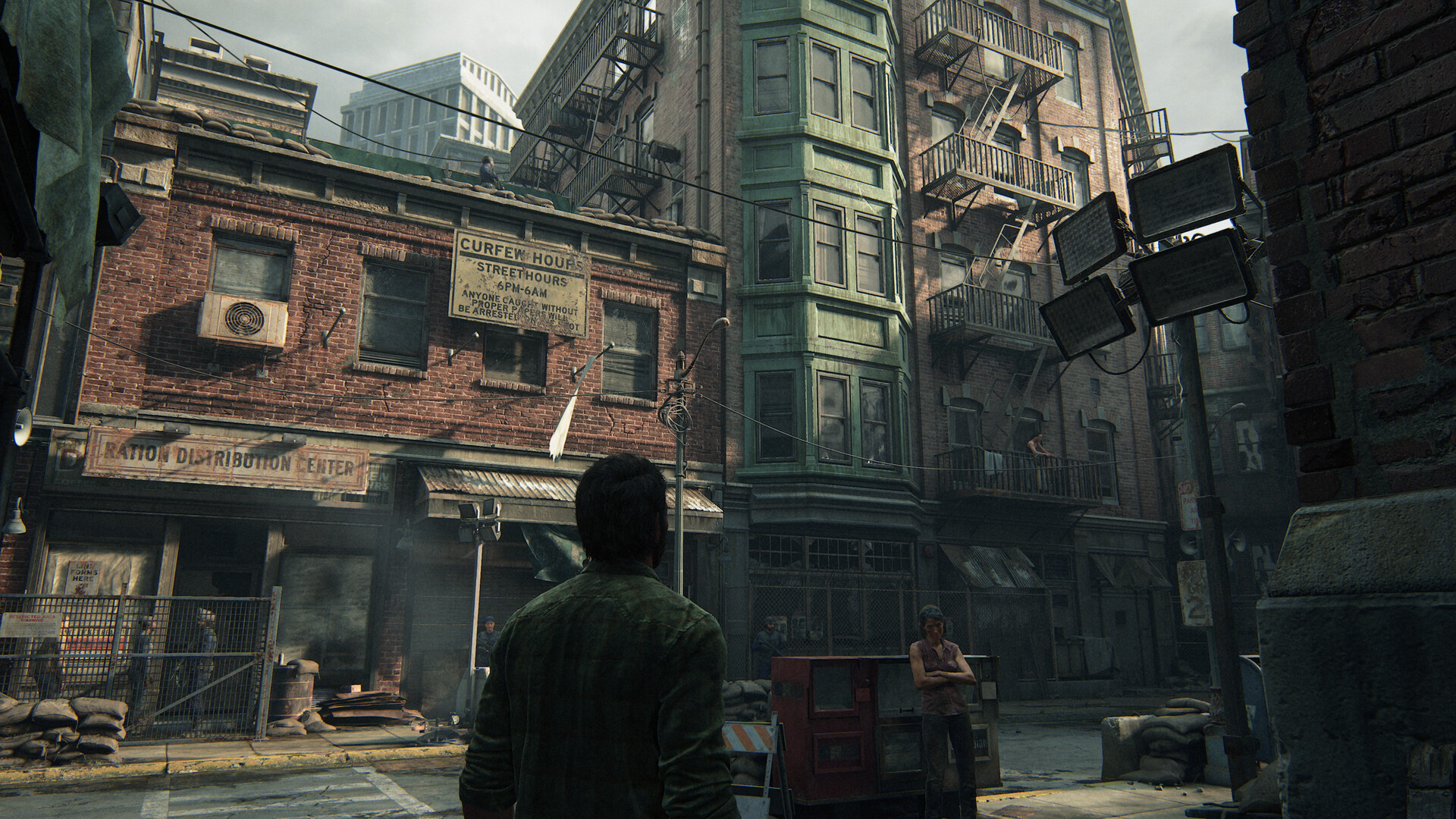
The setting is one of the most meticulously realized post-apocalyptic environments in games. Twenty years after a fungal pandemic — the Cordyceps brain infection — devastated human civilization, the United States has fractured into quarantine zones controlled by a militarized FEDRA government, territories claimed by the rebel faction known as the Fireflies, and the expanses between: the ruins of highways, cities, suburbs, and forests reclaimed by nature.
Naughty Dog's environmental storytelling is extraordinary. Every location tells the story of what happened to the people who lived there before the outbreak. A bedroom with a barricaded door and scratch marks below it. A hospital gift shop looted down to its last item. A museum exhibit on Cordyceps fungus that takes on a different meaning once you understand the game's premise. These details don't require cutscenes or exposition — they are the exposition, readable to any player who takes the time to look.
The game's geography spans the length of the continental United States:
- ▶Boston Quarantine Zone — the controlled, decaying starting environment. FEDRA patrols, curfew, and the specific misery of survival under authoritarian management.
- ▶The Outskirts — the suburbs immediately outside the QZ. Nature has begun to reclaim paved roads. The first true horror sequences take place here.
- ▶Pittsburgh — a city-state of hunter survivors who prey on travelers. Dense urban combat environment.
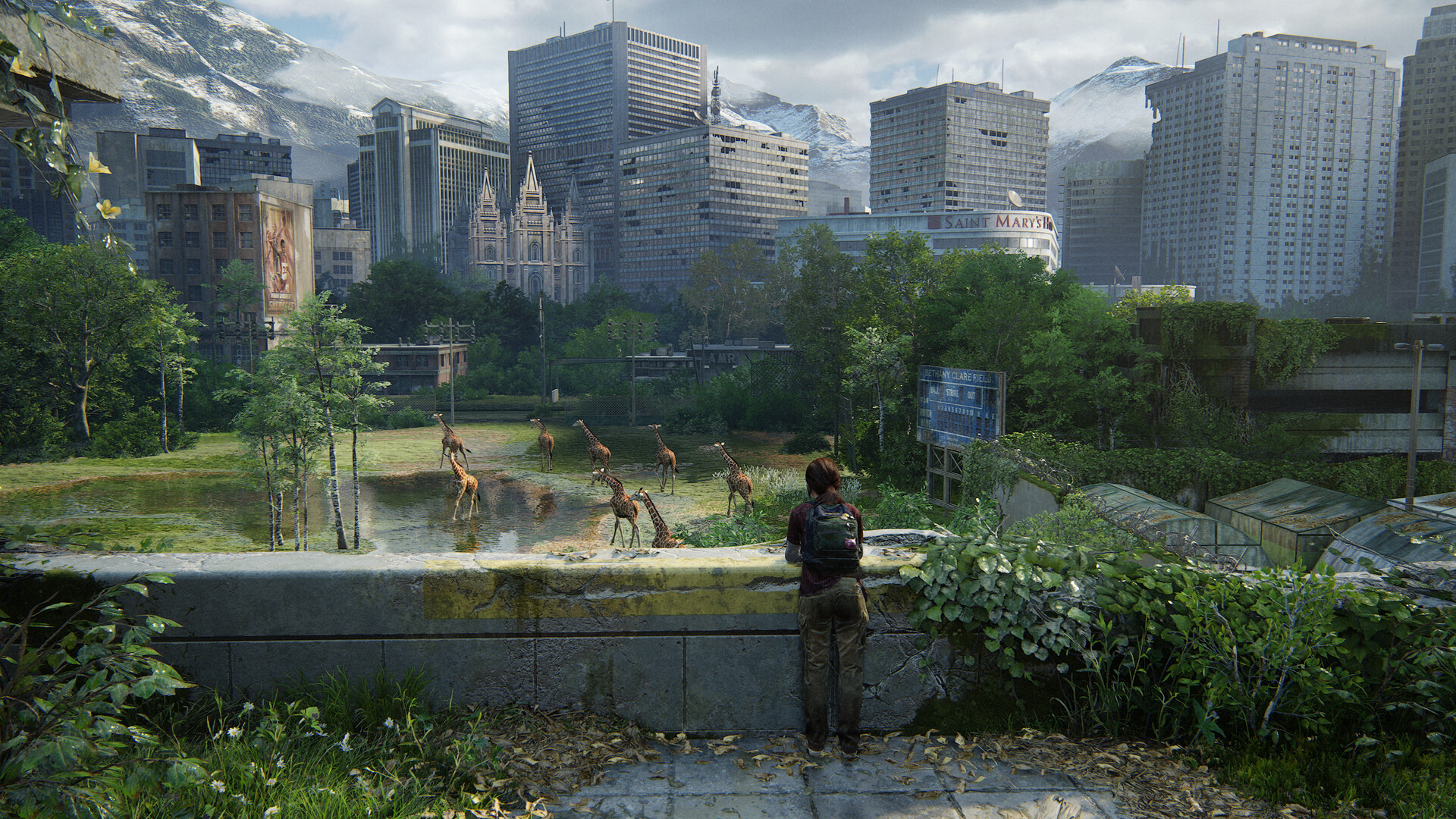
- ▶The University — an abandoned campus where nature has fully won. Giraffes walk the halls. One of the game's most quietly beautiful sequences.
- ▶Jackson, Wyoming — a functioning community in winter. A brief respite that recalibrates emotional tone before the game's final acts.
- ▶Salt Lake City — the destination. The game's conclusion takes place here and remains the most discussed ending in the history of the medium.
Core Gameplay: Survival at Every Level
Resource Scarcity as Design
The Last of Us Part I is an action-adventure with survival horror mechanics built into its resource economy. Ammunition is scarce. Crafting materials — rags, alcohol, blades, tape, sugar — are limited and serve multiple recipes simultaneously. A rag and alcohol can make either a health kit or a Molotov cocktail. A blade and a rag make either a melee shiv or a health kit. These decisions are constant and consequential.
The scarcity is not accidental friction. It is the mechanical embodiment of the game's themes: every resource spent has a cost, and the decision to spend it — on aggression, on healing, on preparation — reflects the kind of survivor you are becoming.
Human vs. Infected: Two Combat Systems
The game's combat differentiates sharply between two enemy types, each requiring distinct approaches.
Human enemies are the more complex tactical challenge. They flank, they communicate, they throw bottles to flush you from cover, and they use numeric advantage aggressively. The game incentivizes stealth and patience — letting enemies separate, taking chokepoints, strangling a situation before it escalates. When combat does erupt, the cover system is functional but never comfortable. The Last of Us is not a game that makes shooting satisfying in the way Uncharted does. Every gun battle feels slightly desperate, which is exactly right.
Infected enemies are categorized by progression stage:
- ▶Runners — recently infected. Still partially human-looking. Fast and aggressive.
- ▶Stalkers — intermediate stage. They hide and ambush rather than charging directly.
- ▶Clickers — blind but with echolocation through clicking sounds. One-hit kill if they grab you. Can only be killed silently with a shiv or noisily with a shotgun.
- ▶Bloaters — late-stage infections, enormous and armored. Throw spore sacks and require sustained fire to bring down.
Navigating infected encounters without resources requires memorizing sound cues, movement patterns, and the specific geometry of each space. The Clicker audio design alone deserves recognition as one of the most effectively unsettling sounds in gaming.
Joel's Crafting and Upgrade System
Joel can craft items at any time using materials found in the environment, including in the middle of combat if you can afford the vulnerability. The skill tree — expanded through discovered Supplements — upgrades health, crafting speed, listen range (a detection pulse that highlights enemies through walls), and weapon handling. These improvements are persistent and carry through the game, making each Supplement discovery feel meaningful rather than cosmetic.
Weapons can also be upgraded at workbenches using scrap: increased clip size, fire rate, stability, draw speed. Decisions about which upgrades to prioritize — given that scrap is also scarce — add another layer to the resource management.
The Listening Mechanic and Stealth Architecture
Joel's listen mode — activated by holding L2 on controller — outlines enemies in yellow through walls and cover, giving the player spatial awareness that a real person in that environment would develop through sound. It is a slight but significant mechanical accommodation that the game builds its encounter design around.
The encounters are not puzzles with single solutions. They are sandboxes with resource constraints. Finding the cleanest path through a room of hunters — the one that costs the least ammo, creates the fewest alerts, and leaves the most materials for the next room — is the game's core strategic loop, and it is exceptionally well-constructed.
Moments That Define the Journey
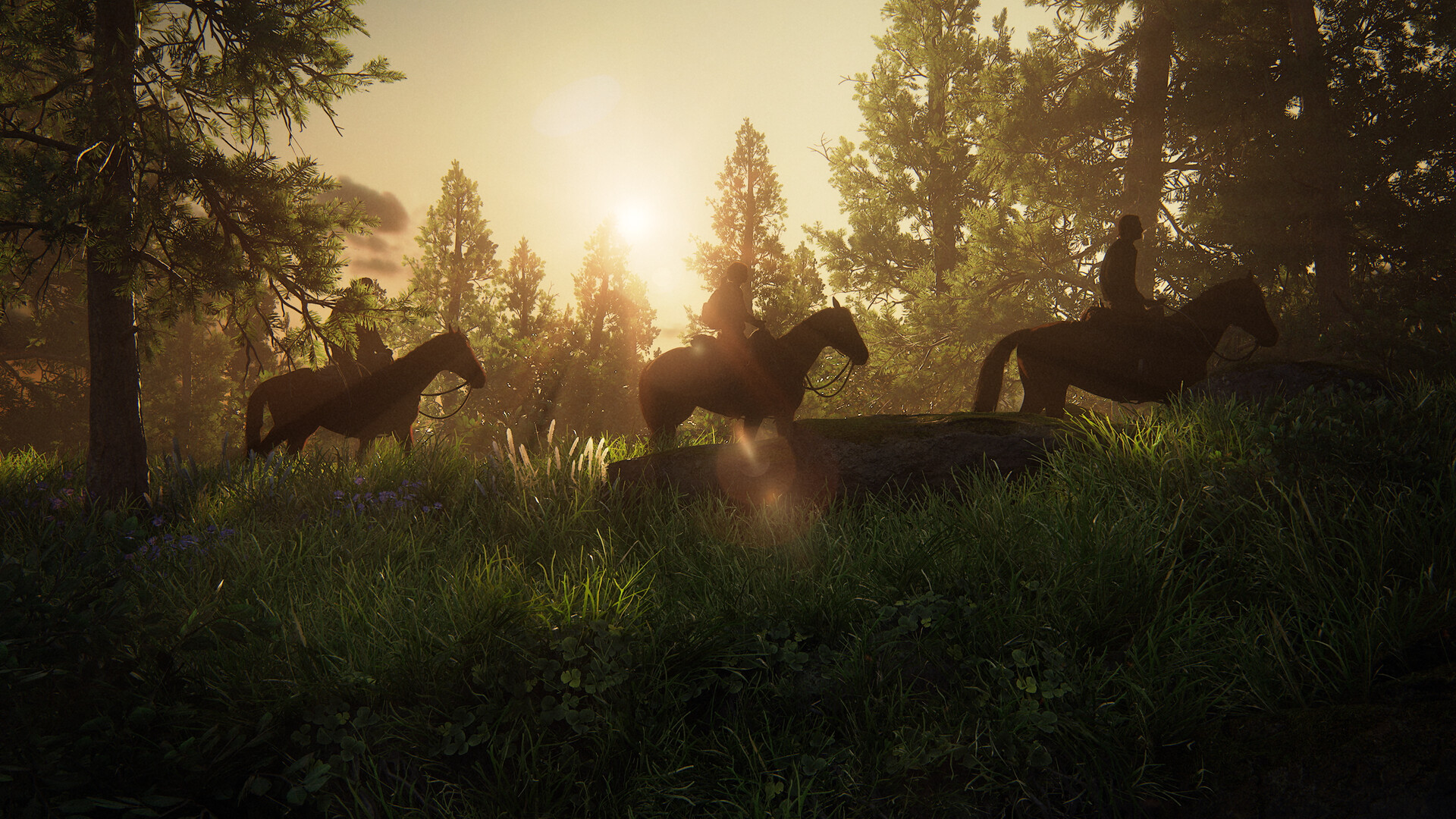
The Prologue is one of the most effective opening sequences in games. Before the game's world is established, before the mechanics are introduced, before the player fully understands what they're playing — the prologue happens. It is brief, devastating, and functions as an emotional premise that everything else in the game is a response to.
Bill's Town — the game's first extended side-character arc — introduces the relationship between survival and humanity through a character who has made peace with jettisoning the latter. Nick Offerman's performance in the HBO adaptation brought mainstream attention to this section, but the game's version, with its interactive exploration and optional notes, remains the definitive experience.
The University sequence achieves something rare in post-apocalyptic games: genuine beauty. The campus in ruin, populated by animals that have no frame of reference for human civilization, creates a sense of melancholy that the more combat-focused sections can't. There's a giraffe encounter here that players still describe years after first playing.
Winter is the game's tonal shift. Ellie's arc as the playable character in this chapter — hunting, surviving alone, navigating a threat that is both infected and human — is the game's narrative highpoint. The chapter that follows is its moral one.
The Hospital ending is the most debated conclusion in gaming. The decision Joel makes, the logic behind it, and whether the player endorses or condemns it — this remains an active conversation more than a decade after the game's release. The fact that reasonable people land in different places is a mark of the writing's quality.
Accessibility and Modern Features
The Last of Us Part I includes one of the most comprehensive accessibility suites ever released in a major title: full controller remapping, audio description for cutscenes, visual motion sickness options, adjustable camera sensitivity for aiming, and extensive difficulty customization including individual sliders for enemy detection speed, resource availability, and damage taken.
These features weren't retrofitted. They were part of the PS5 rebuild's design priorities, informed by Naughty Dog's work on accessibility in The Last of Us Part II. The result is a game that is more playable for more people than either the original PS3 version or the PS4 remaster, without compromising anything for players who want the default experience.
Community Reception
The Last of Us Part I on Steam carries a Very Positive rating with 82% positive reviews. The lower percentage relative to the PS5 version's reception reflects the rough PC launch state — a narrative the reviews have not fully corrected even as the game itself has been significantly patched. Players who experienced the game after the performance patches consistently rate it more favorably.
Metacritic score: 89 (PC) — reflecting the underlying quality of the game beneath the port issues.
The HBO television series (premiered January 2023) brought significant new attention to the game shortly before the PC launch, creating a wave of first-time players who knew the story and wanted to experience it in its source medium. The community has remained active around both the game and the show, with discussion spanning lore analysis, the ethics of the ending, and anticipation for The Last of Us Part III.
Tips for Surviving the Journey
1. Listen mode is not cheating. It is a core mechanic. Use it before entering every new room.
2. Craft health kits before combat, not during. If you enter an encounter with crafting materials and no health kits, you're already behind.
3. Shivs are worth hoarding for Clickers and locked doors. Shivs unlock specific optional rooms containing valuable items. Don't spend them all on stealth kills.
4. Bricks and bottles are infinitely valuable. Throwing them draws enemies into positions you can exploit. They are the cheapest form of tactical control in the game.
5. Don't fight every encounter. Some sections can be walked through entirely by managing line of sight and crouching. The game rewards restraint.
6. Supplements are often in side rooms. Always check every branch of a level before progressing. Upgrades make meaningful differences, particularly in the game's later sections.
7. Ellie is not as fragile as she seems. In AI companion mode, Ellie is functionally immune to enemy detection and doesn't contribute to the "detected" state. She will help you in combat. Trust her.
Why This is a GamePeak Pick
GamePeak Picks is reserved for games where "have you played this?" is a genuine cultural question — not a review recommendation but an inquiry into a shared experience. The Last of Us Part I is among the clearest possible qualifications for that status.
The game defined a generation's understanding of what narrative games could accomplish. It demonstrated that AAA production and emotional honesty were not mutually exclusive. It created two characters — Joel and Ellie — whose relationship remains one of the most studied and debated in the medium. And it delivered a conclusion that, twelve years on, people still argue about with genuine passion.
The PC version — now stable, fully accessible, and visually unmatched by any previous version — is the best way to play this story if you haven't already. And if you've played it before but not in its rebuilt form, the improvements are substantial enough that a return is worth your time.
Final Verdict
“The Last of Us Part I is proof that the best games don't age — they wait for technology to catch up. This is the definitive version of one of the most important games ever made, presented with a level of craft that honors the original while surpassing it visually and mechanically. An essential GamePeak Pick, without qualification.