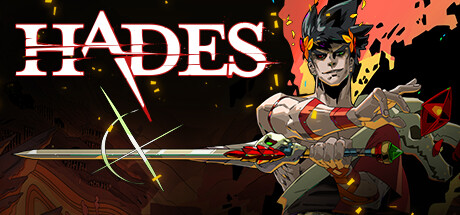
Editor's note: this article summarizes published reviews, store data and community reception. GamePeak did not run its own playtest, so no GamePeak score is given.
Steam Rating: Overwhelmingly Positive (120,000+ reviews) | Metacritic: 93/100 (PC)
Developer: Supergiant Games | Release Date: September 17, 2020 (1.0) | Steam Price: $24.99
“Hades swept the 2020 Game of the Year conversation so thoroughly that the debate was essentially over before December. The Steam community's verdict — "the roguelike genre's masterclass," "the only game I've played a hundred runs of without ever feeling bored," "proof that narrative and roguelike design can not only coexist but amplify each other" — is the rare consensus that actually matches the reality of the experience. Finding genuine criticism of Hades takes effort. That's not hype. It's accurate.
Escaping the Underworld: A Son, a Father, and a Very Long Journey
Zagreus is the son of Hades, Prince of the Underworld. He wants to leave. His reasons evolve across the game's arc — at first a vague yearning for the surface world and the Olympian gods, then the search for his mother, then something more complex and personal that the game reveals across dozens of runs.
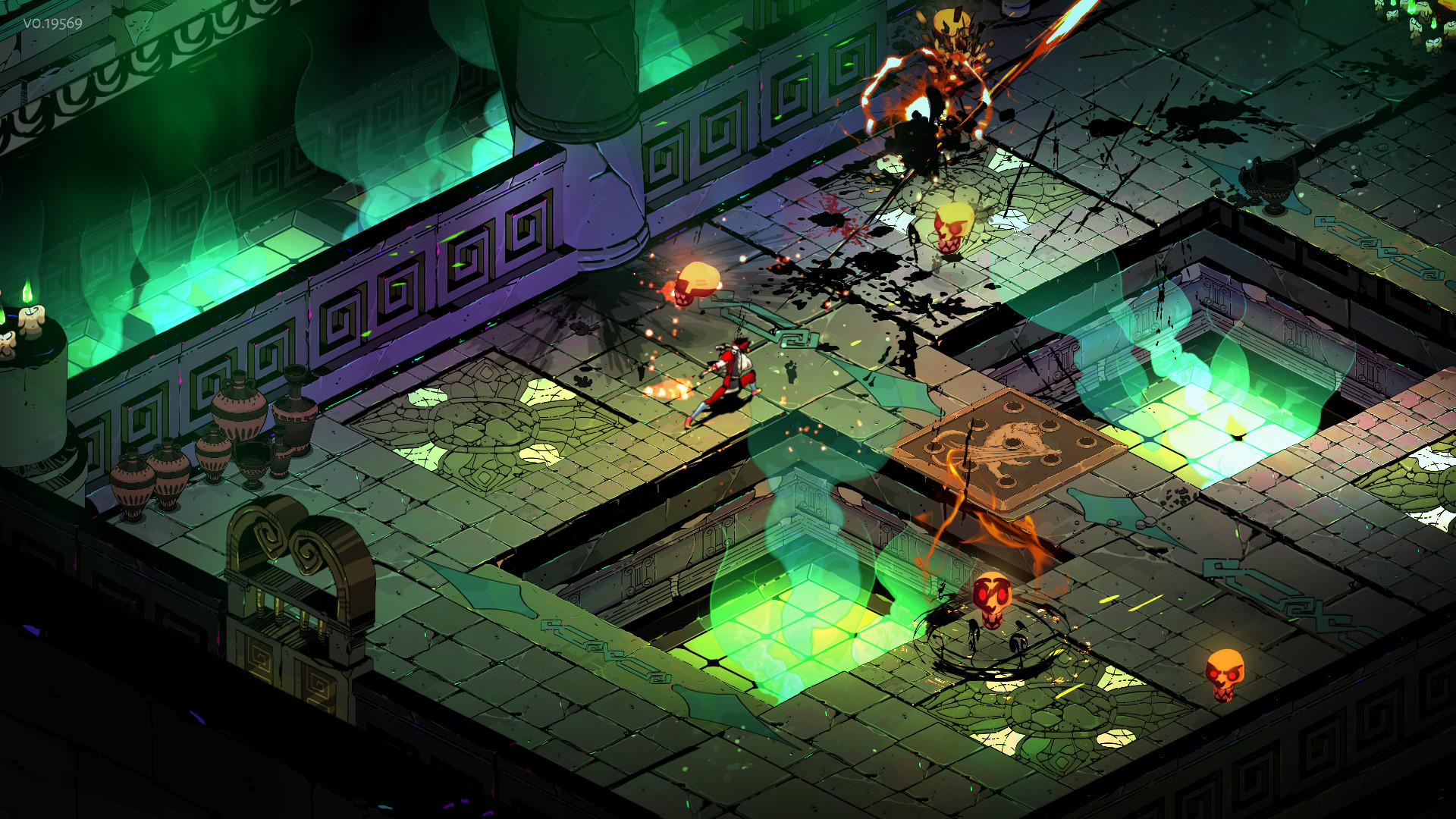
Hades, naturally, wants him to stay. The Lord of the Underworld deploys the full machinery of the afterlife against his son: the shades of Tartarus, the Furies, the Hydra, and the legendary hero Theseus and the Minotaur as the penultimate guardian. Death doesn't stop Zagreus — it returns him to the House of Hades, where he picks himself up and tries again.
This premise is Supergiant's masterstroke. The one narrative problem that roguelikes historically cannot solve is the disconnect between player repetition and story continuity. Why does your character keep dying and restarting, and what does that mean for the world? Hades answers this question not by working around it but by making death itself the story's mechanism. Every run — successful or failed — advances character relationships. Every return home triggers new dialogue. The loop and the narrative are the same structure.
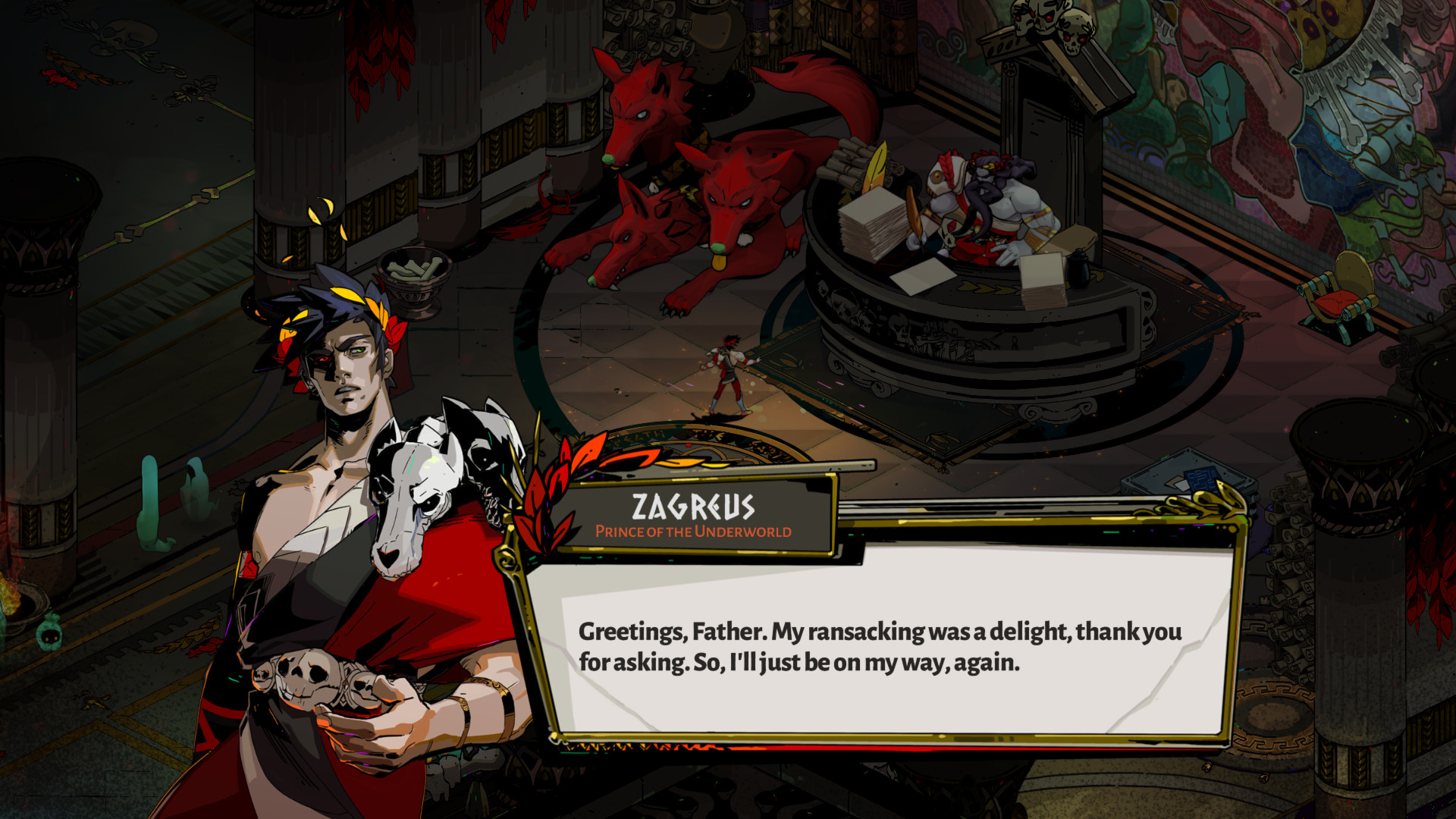
The cast is extraordinary:
- ▶Hades: Cold, dignified, and genuinely complex — a father whose motives are more ambiguous than they first appear
- ▶Achilles: Zagreus's trainer, carrying his own unresolved tragedy with Patroclus across the Asphodel Meadows
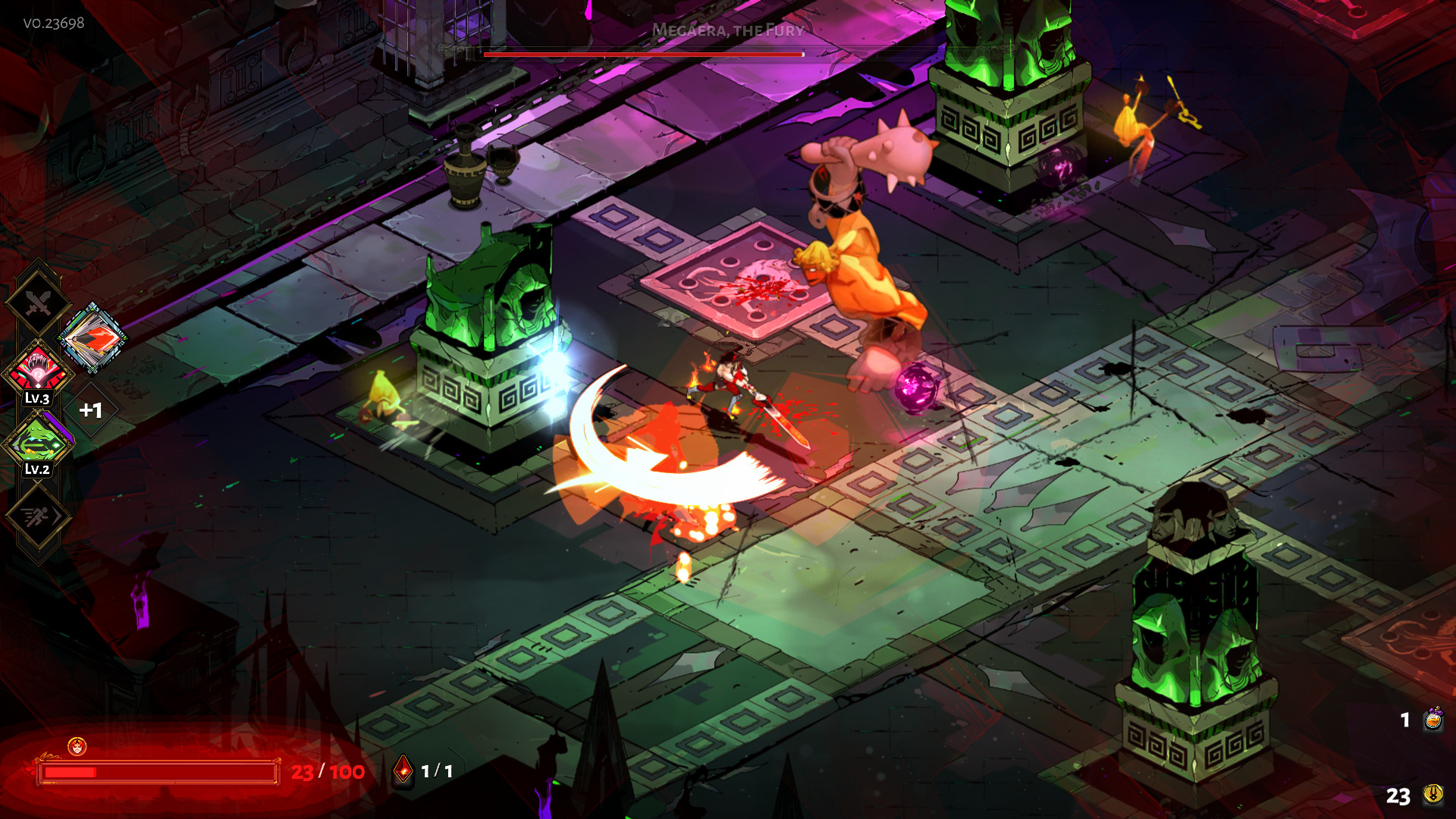
- ▶Megaera: The Fury who serves as the game's first recurring boss and one of the most layered characters
- ▶Hypnos: The god of sleep, waiting at the end of every run with cheerfully useless commentary
- ▶Olympian Gods: Athena, Ares, Dionysus, Artemis, and more — each sending their blessings as Zagreus escapes upward
The Run Loop: Every Death Is Progress
The structure is deceptively simple: navigate four regions of the Underworld (Tartarus, Asphodel, Elysium, the Temple of Styx) through rooms of enemies, choose boons and upgrades along the way, reach the surface. Die, return to the House of Hades, spend resources, grow stronger, try again.
The genius is in the layering.
The Boon system is the run-to-run variable heart of Hades. Each Olympian god offers abilities that augment Zagreus's attacks, special attacks, dashes, and casts in distinct ways. Athena's Divine Strike adds a damage-deflecting shimmer to attacks. Ares's Doom inflicts lingering damage. Dionysus's Hangover stacks a poison-adjacent drunkenness debuff. Combining multiple boons from the same god — or specific cross-god pairings called Duos — creates exponential power spikes. Building toward those synergies is the strategic engine of every run.
The Mirror of Night converts resources gathered during runs into permanent upgrades: more base health, faster death-defiance recovery, starting resources on future runs, bonus currency from encounters. Every failed run still advances your power level. The death loop is not punishment — it is the game's XP system.
Six Infernal Arms with four Aspects each provide 24 distinct weapon configurations:
- ▶Stygian Blade: The introductory sword, versatile and well-rounded
- ▶Heart-Seeking Bow: Range-focused, rewarding precise aim
- ▶Shield of Chaos: The only defensive weapon, with a block-and-riposte flow
- ▶Twin Fists: Rapid melee with high mobility
- ▶Eternal Spear: Long-reach with powerful throw mechanics
- ▶Adamant Rail: A ranged weapon with a grenade secondary
Different Aspects transform base weapons into entirely new play patterns. Aspect of Beowulf turns the shield into a dash-and-explode specialist. Aspect of Guan Yu cuts the spear's base damage for massive healing on hit. Discovering these variants and building around them extends the game's novelty deep into the triple-digit run count.
Combat: Immediate, Readable, and Endlessly Satisfying
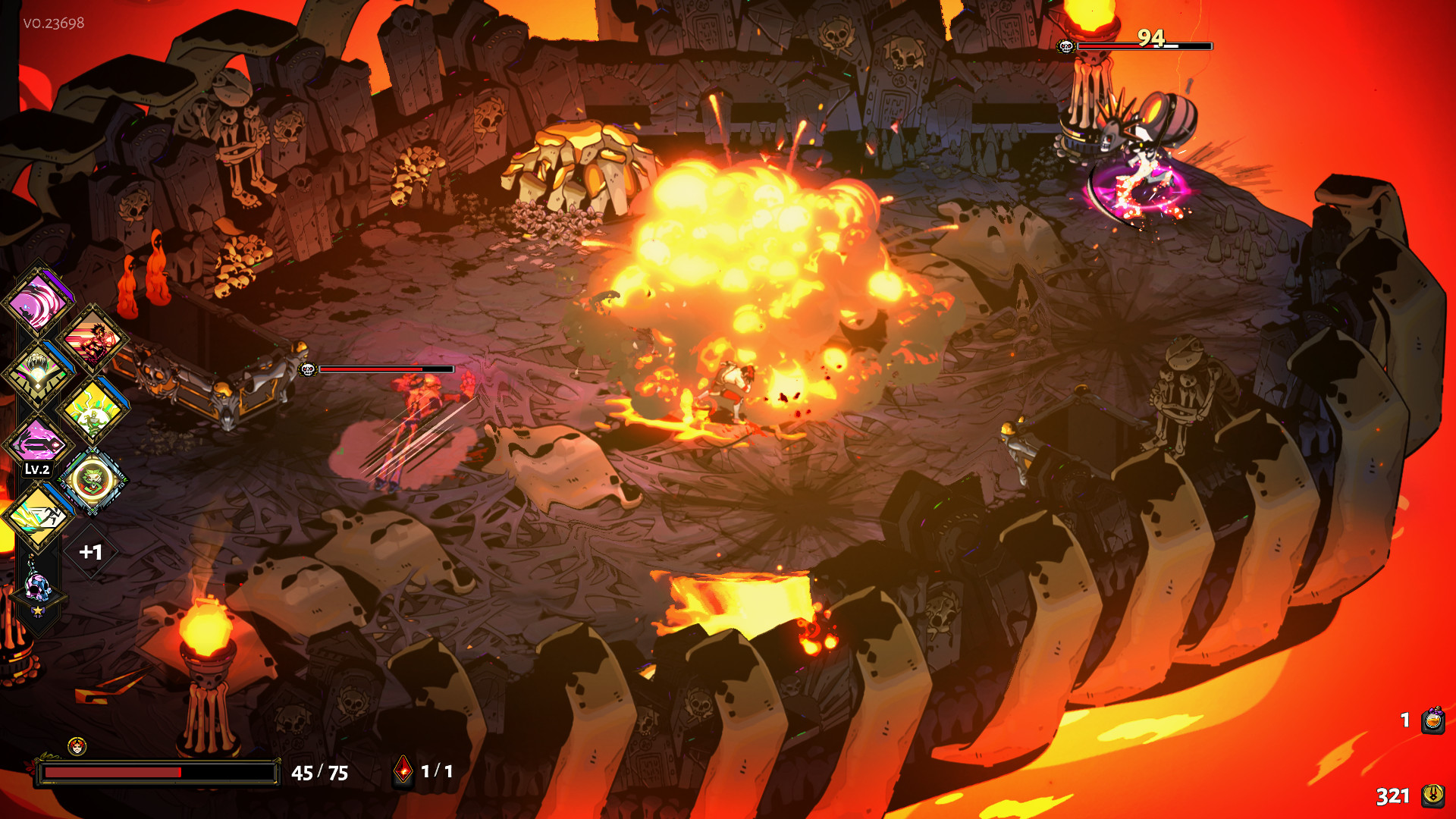
Supergiant Games has a reputation for action that feels immediately right — Bastion, Transistor, Pyre each had distinct tactile qualities. Hades represents the studio's combat design at its most refined. The six-verb toolkit (attack, special, dash, cast, call, and weapon-specific) is simple enough to onboard instantly and complex enough to support indefinite skill development.
Dash is the central skill expression point. At baseline, it provides brief invincibility frames and repositioning. With the right boons, it becomes an offensive tool that deals damage, heals, inflicts status effects, or refunds cooldowns. The difference between a player who dashes reactively and one who dashes proactively — setting up an angle, triggering a buff, maintaining flow — is the distance between clearing Elysium at 80% health and arriving there at 20%.
Death-Defiance — a stored resurrection that activates automatically at zero health — functions as a training wheel for new players and as a tactical resource for experienced ones. Understanding when your Death-Defiance will cover a risky play versus when to play conservatively is a genuine skill.
Characters and Writing: A New Standard for Roguelike Narrative
Hades won the BAFTA for Narrative in 2020 — in competition with traditional narrative games, not just roguelikes. This is not an honorary recognition of novelty. The writing is genuinely excellent.
The script runs to tens of thousands of lines. After thirty, forty, fifty runs, new dialogue still surfaces. Characters' relationships with Zagreus evolve based on choices: the Nectars you give them, the runs you complete, the story beats you unlock. Achilles's relationship to Patroclus — separated across different Underworld regions — builds over dozens of conversations into one of gaming's most affecting love stories. Hades himself transitions from antagonist to a character of genuine complexity whose motives are not what they first appear.
The Keepsake system lets you equip a gift from a specific character at the start of a run, providing a bonus tied to their divine affiliation while wearing their memento. It's a mechanical expression of relationship — choosing which god or ally to carry with you each attempt.
The Soundtrack: Supergiant Does It Again
Darren Korb's score for Hades is his fifth for Supergiant and his most genre-fluid. He coined the term "Underworld Rock" to describe its blend of ancient Greek instrumentation, heavy guitar, and electronic production. The result sounds like nothing else in games — simultaneously classical and contemporary, deeply appropriate to a mythological setting and viscerally exciting during combat.
Each region has its own musical identity. Tartarus hits with full-band aggression. Asphodel slows into something more melancholic. Elysium takes on an almost triumphant martial quality. Boss encounters get heavier mixes of each theme. The music is, in practical terms, a performance alongside the gameplay rather than a background layer.
Tips for New Players
Hades is one of the most accessible roguelikes ever made, but early runs before permanent upgrades accumulate can still be rough.
Early investment priorities:
- 1Prioritize Death-Defiance unlocks in the Mirror of Night — extra lives matter more than raw stats early
- 2Max Health upgrades in the Mirror are critical for the first twenty runs
- 3Learn to identify strong Boon pairings — Athena's deflection abilities are consistently powerful across all weapon types
- 4Don't skip Chaos Gates — the short-term penalty is usually worth the long-term upgrade
- 5Gift Nectars to NPCs you encounter often — relationship unlocks include some of the game's best permanent upgrades
The "true" ending of Hades requires multiple successful escape attempts after clearing the first run. The story continues well beyond the first credits roll, and the final resolution of Zagreus's arc is worth every attempt that led there.
Final Verdict: A Perfect Game
"Perfect" is a word that should be used rarely. Hades earns it. There is no meaningful gap between what the game attempts and what it achieves. The combat feels exactly as it should. The narrative works in a way the genre had never managed. The characters are written with more care than most story-first games. The soundtrack is a masterpiece. The progression respects the player's time while maintaining challenge.
Supergiant Games built this across three years in a partially public Early Access process, iterating on community feedback without compromising the vision. The result is one of the finest games of the 2020s, from a studio that has never made a bad game.