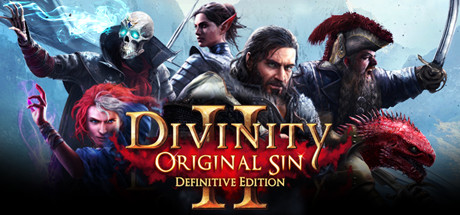
Editor's note: this article summarizes published reviews, store data and community reception. GamePeak did not run its own playtest, so no GamePeak score is given.
Steam Rating: Overwhelmingly Positive (100,000+ reviews) | Metacritic: 93/100 (PC)
Developer: Larian Studios | Release Date: August 31, 2018 (Definitive Edition) | Steam Price: $44.99
“The Steam community consensus on Divinity: Original Sin 2 is unusually unified for a game this complex: it is the high-water mark of the CRPG genre, the direct philosophical and mechanical precursor to Baldur's Gate 3, and one of those rare games where the claim "you can play through it ten times and have ten different experiences" is not marketing hyperbole but a factual description of the design. Criticism concentrates on the steep early learning curve — which is legitimate — but those who push through it uniformly describe the experience as one of their most memorable in gaming.
Rivellon: A World Running Out of Gods
Source — the raw magical energy flowing from the Void — is both the world's most powerful force and its greatest existential threat. Uncontrolled, Source tears open the membrane between the living world and the Void, letting corrupted entities called Voidwoken pour through. The Divine Order, a theocratic military organization, responds by hunting and imprisoning Sourcerers — those who can wield Source magic.
You are a Sourcerer. The game begins with you in chains aboard a prison ship called the Merciless, awaiting processing. The escape from this vessel is your first objective, but it is only a prologue. Within hours, the world reveals its true stakes: the gods are gone, the Divine is dead, and the Void is encroaching. Someone must ascend to godhood to seal the breach. The question — and the game's central tension — is who, and at what cost.
Six fully-realized Origin Characters serve as both playable protagonists and potential companions:
- ▶Sebille: A lizard former ambassador fleeing the Divine Order, carrying a song she can't unhear
- ▶Fane: An undead scholar from a civilization that predates the gods, who sees the current world with ancient and detached eyes
- ▶Lohse: A human entertainer possessed by a demon she cannot control
- ▶Beast: A dwarven outlaw and former privateer wanted by his own queen
- ▶Ifan ben-Mezd: A mercenary with a contract to kill the Divine's candidate — possibly you
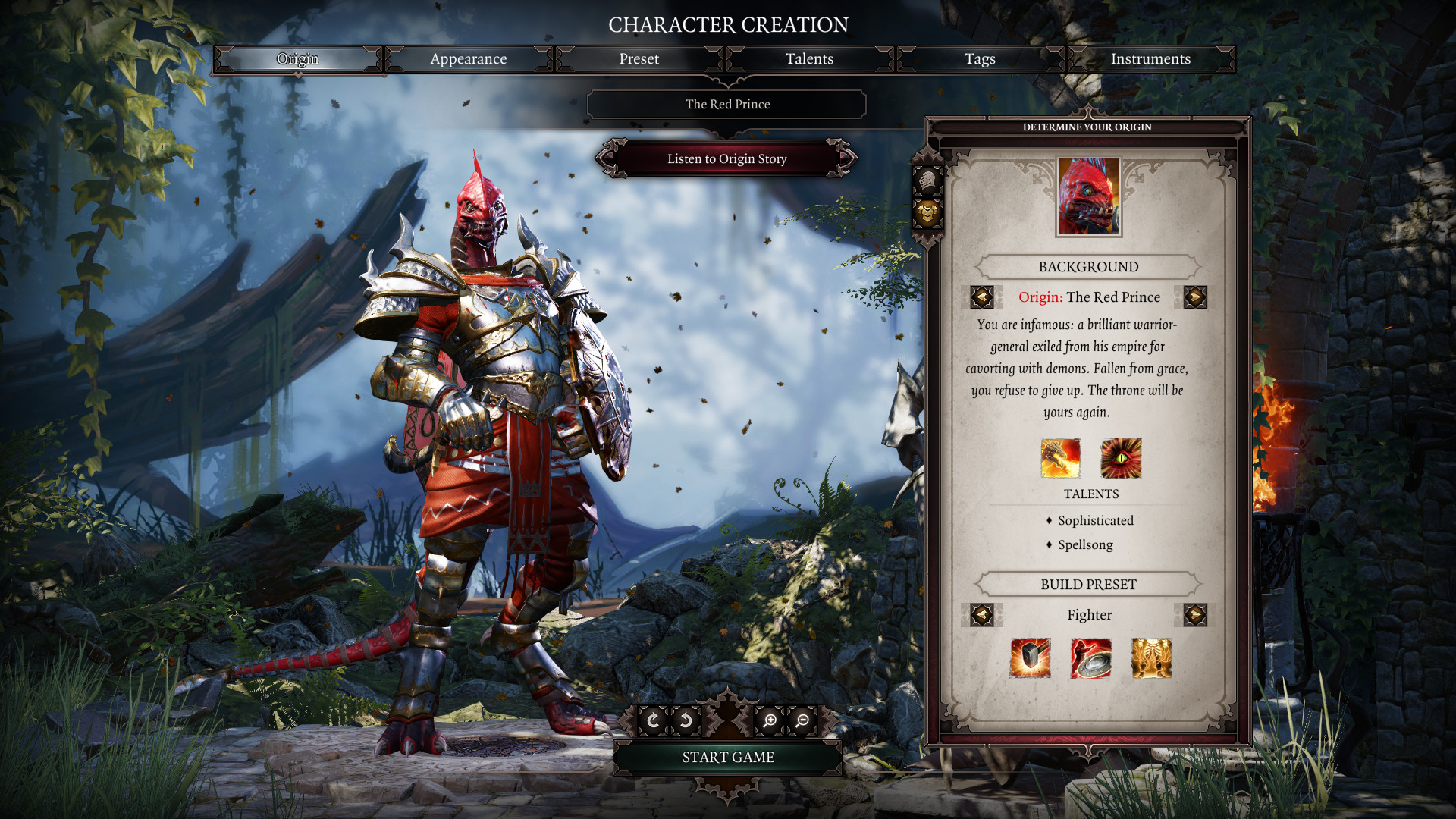
- ▶The Red Prince: An exiled lizard prince in search of a prophesied consort and a path back to the Dragon Knight legacy
Each Origin Character has a fully-written personal questline that intertwines with the main narrative. Play as one; recruit others as companions. Their opinions on your decisions, their personal crises, and their individual endings make every playthrough feel genuinely populated.
Combat: Environmental Chess at Scale
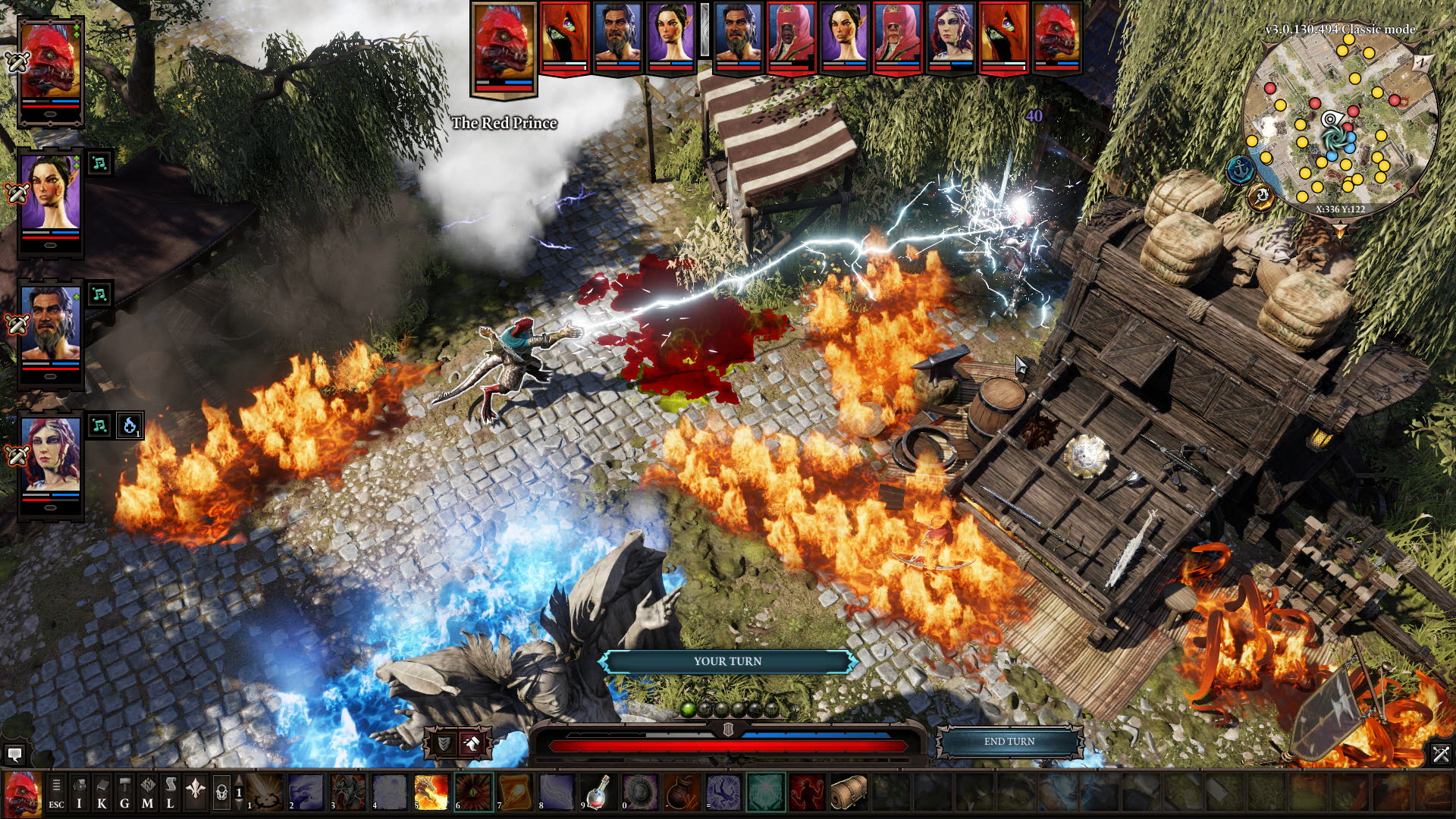
Divinity: Original Sin 2's turn-based combat is built on a foundation familiar to CRPG veterans — action points govern movement and actions per turn — but the environmental interaction layer transforms it into something radically different.
The surface and cloud system:
- ▶Cast a water surface, then chain-lightning through it for full area electrification
- ▶Ignite an oil barrel to create fire terrain that persists
- ▶Combine poison gas with flame for explosions
- ▶Freeze water surfaces, then shatter frozen enemies with blunt attacks for massive damage
- ▶Blood surfaces spread status effects and feed Necromancer abilities
Every fight becomes an improvised chemistry experiment. The game doesn't teach you these interactions via tutorials — you discover them through curiosity and occasional catastrophic self-inflicted accidents.
The height advantage system adds another dimension: elevated positions grant attack damage and accuracy bonuses; attacks from below suffer penalties. Taking control of high ground in the opening turn of a difficult fight is a genuine strategic priority, often worth spending mobility rather than dealing damage.
Source abilities — powerful once-per-encounter (or fight) spells that consume Source points — punctuate fights with spectacular eruptions. Each class has distinct Source skills: Necromancers can drain the life from an entire battlefield; Summoners can call godlike avatars; Wizards can wipe enemies off the map with elemental devastation.
The Truth About Meaningful Choices
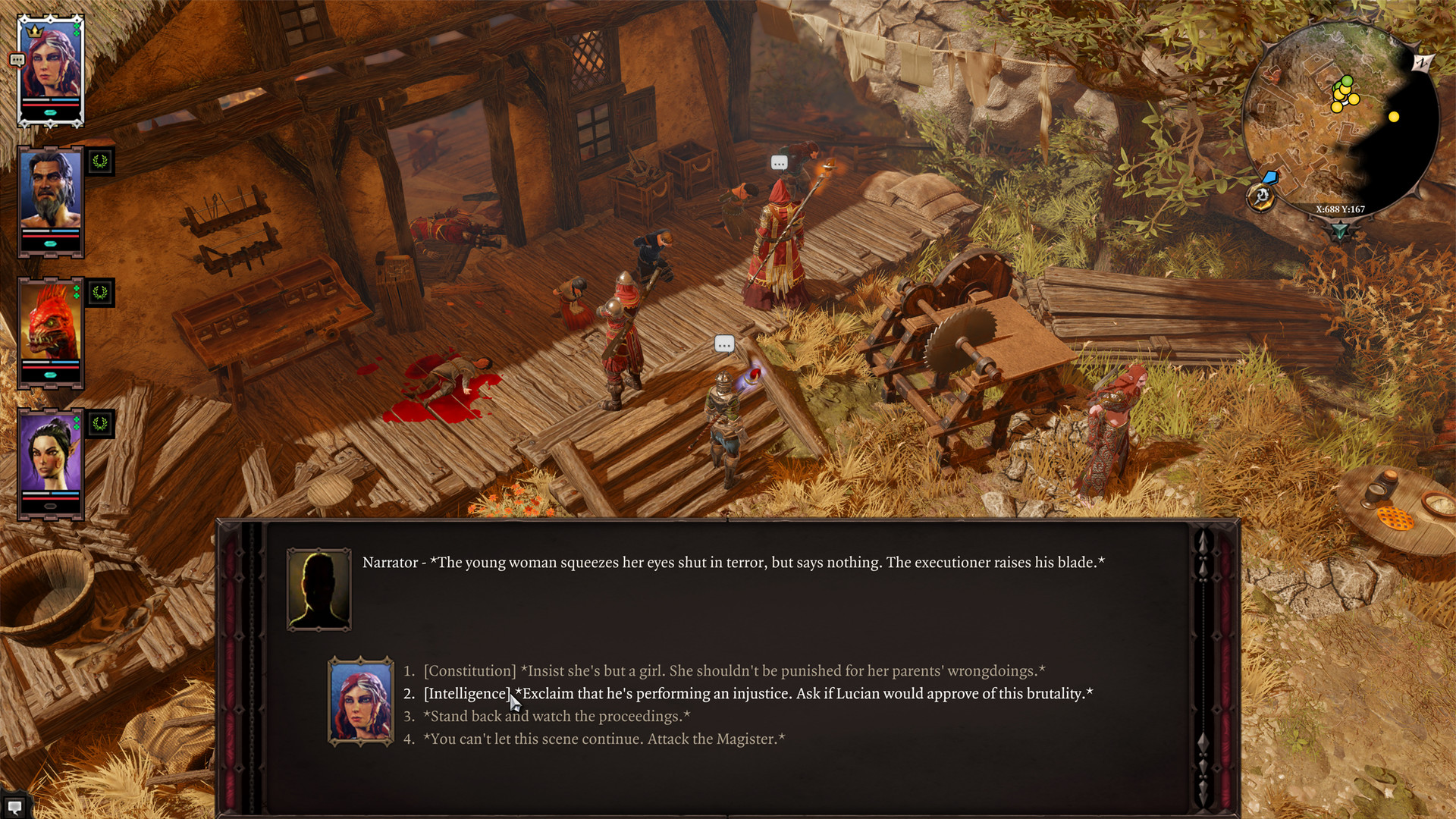
Many RPGs promise meaningful choices and deliver cosmetic variation. Divinity: Original Sin 2 delivers something closer to genuine consequence — decisions that close doors, permanently kill characters, and cascade through subsequent questlines in ways you often don't realize until hours later.
Examples of real branching:
- ▶Killing the target of a quest before receiving it permanently locks several related quests
- ▶Faction alignment during Act 2 fundamentally changes who you can deal with in Act 3
- ▶The method used to complete major story beats in each act alters which information you have available later
- ▶Speaking with Spirits (via the Spirit Vision skill) of dead NPCs unlocks hidden questlines that are entirely invisible on a first playthrough
The game also trusts players to make catastrophic mistakes and live with them. No hand-holding, no rollback prompts. Save often.
Four-Player Co-op: The CRPG Genre's Best Multiplayer Mode
Up to four players can each control an Origin Character simultaneously through the entire campaign. The result is something no other CRPG achieves at this scale: genuine collaborative roleplaying where party members genuinely disagree.
When three players want to ally with the magisters and one is playing Fane, who has diametrically opposed motives, the in-party debate becomes part of the game. When two players vote to spare an NPC and two vote to kill them, the game forces a resolution. This friction is not a problem — it is the point. The co-op mode creates emergent drama that no scripted game can manufacture.
Two-player co-op splits characters differently: each player controls their main character plus one companion. The pace is slower and more deliberate, often leading to the most deeply explored single playthroughs in the community.
Definitive Edition Improvements
The Definitive Edition released in 2018 was a substantial revision:
- ▶Act 4 complete redesign: The original endgame area was rebuilt from scratch based on player feedback
- ▶Game Master Mode: A full toolset for creating and running custom campaigns, enabling a thriving community of fan-made adventures
- ▶Arena Mode: Competitive PvP combat using the full tactical ruleset
- ▶Extensive rebalancing: Years of post-release feedback integrated into class, item, and combat balance
The version sold on Steam is the Definitive Edition. There is no additional purchase needed.
Tips for New Players
Highly recommended for first-time players:
- 1Choose an Origin Character rather than a custom character on your first run — the personal questlines add enormous texture to the world
- 2Pick up Pet Pal talent for at least one party member — you can talk to every animal in the world, and many have quests
- 3Invest in Teleportation early — it's the most versatile spell in the game for both combat and exploration
- 4Save before every significant NPC interaction — many choices close doors you can't reopen
- 5Don't be afraid to experiment with builds and fail — the game expects experimentation
Difficulty is fully adjustable at any time. Explorer Mode significantly reduces enemy stats for story-focused players; Tactician Mode cranks combat difficulty for veterans who want a genuine strategic challenge. There is a configuration that works for any skill level.
Final Verdict: The Blueprint for the Modern CRPG
Divinity: Original Sin 2 is the game that convinced a generation of RPG developers that CRPGs could be simultaneously complex, deeply narrative, mechanically innovative, and massively popular. The 93 Metacritic score and hundreds of thousands of overwhelmingly positive Steam reviews represent years of sustained community love, not a launch-window spike.
Larian's subsequent Baldur's Gate 3 is a direct descendant — more polished, better resourced — but Original Sin 2 is the work that proved the formula could work at scale. Playing it today is playing a landmark.
Buy Divinity: Original Sin 2 — Definitive Edition on Steam →