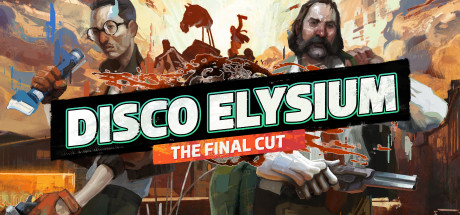
Editor's note: this article summarizes published reviews, store data and community reception. GamePeak did not run its own playtest, so no GamePeak score is given.
# Disco Elysium: The Final Cut — The Most Ambitious RPG Ever Written
Developer: ZA/UM | Release Date: March 30, 2021 (Original: October 2019) | Genre: RPG / Adventure
Steam Rating: Overwhelmingly Positive (87,000+ reviews) | Metacritic: 97/100
Buy on Steam: View on Steam | Price: $39.99
“Across Steam and the broader gaming press, Disco Elysium draws reactions that go beyond conventional praise. Reviewers describe it as "better than the best novel I've read," "proof that games don't need combat to be tense and dramatic," and "I can't believe your own skills talk to you like characters — and they're right about things you don't want to admit." The consensus is that it pushes the RPG concept of "being your character" further than any other game in the genre, while simultaneously delivering social and political commentary of unusual sharpness and depth. It swept GOTY awards in 2019 and remains a touchstone for arguments about games as literature.
A Dead Man Hanging from a Tree — Your Introduction to Martinaise
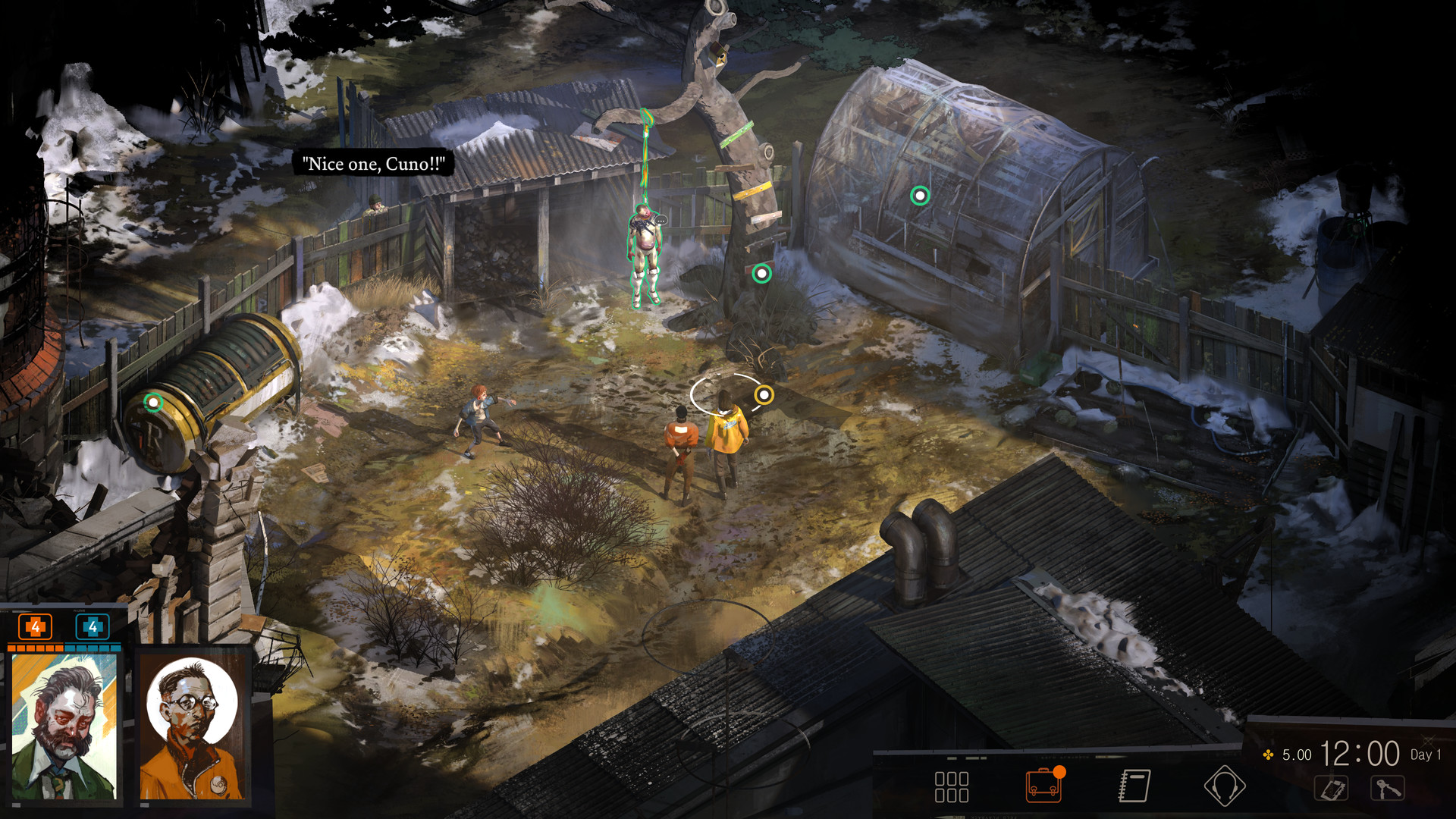
The game's opening is deliberately disorienting. You wake on the floor of a wrecked hotel room with no memory. Your name is gone. Your job is gone. Your face in the mirror is a stranger's face. The room is a disaster of empty bottles and bad decisions. And outside the window, from a tree in the courtyard, a body has been hanging for several weeks.
You are, apparently, a detective. There is a dead man, and a case to solve, and a partner waiting for you who seems deeply unimpressed by your current condition. Your first task is to locate your own pants.
This is Disco Elysium: a murder mystery wrapped around an identity crisis, set in the harbor district of Martinaise in the fictional city of Revachol. The case draws you into the city's living history — a strike by dockworkers, competing corporate and political interests, the ghosts of a failed communist revolution, the grinding poverty of people who were promised something better. The game uses its murder mystery as a mechanism for a rigorous, sometimes savage, always darkly funny examination of idealism, failure, and what people do when the world they wanted never arrives.
Martinaise Harbor — A World That Is Also a Political Argument
The harbor district of Martinaise is not a backdrop. It is a thesis.
The striking dockworkers have been on the picket line for weeks. Their dispute with the Pale Company — a corporate entity that is as international and faceless as capital always is — is not simply a labor negotiation. It is a question about who owns what and whether the people who do the work have any claim on the world they maintain. The company's negotiator, Dora Cuarell, is cold, professional, and inhumanly rational. Conversations with her are among the game's sharpest illustrations of why the confrontation between labor and capital tends to end the same way.
The RCM — Royal Morralow Constabulary, your employer — is a law enforcement body corroded by institutional failure and moral compromise. The irony of being an RCM officer investigating a case that implicates the very social order you nominally represent is not subtle. The game does not want it to be subtle.
Revachol itself is a city haunted by a communist revolution that failed. The Antecentennial, the Suzerainty, the Commune — these historical periods are referenced constantly, in graffiti, in the testimony of aging revolutionaries, in the ruins that the city has never quite rebuilt. What remains after a failed revolution is not the world the revolutionaries wanted. It is this: poverty, disappointment, and the ideological debris of people trying to explain to themselves why it went wrong.
Twenty-Four Skills, All of Them With Opinions
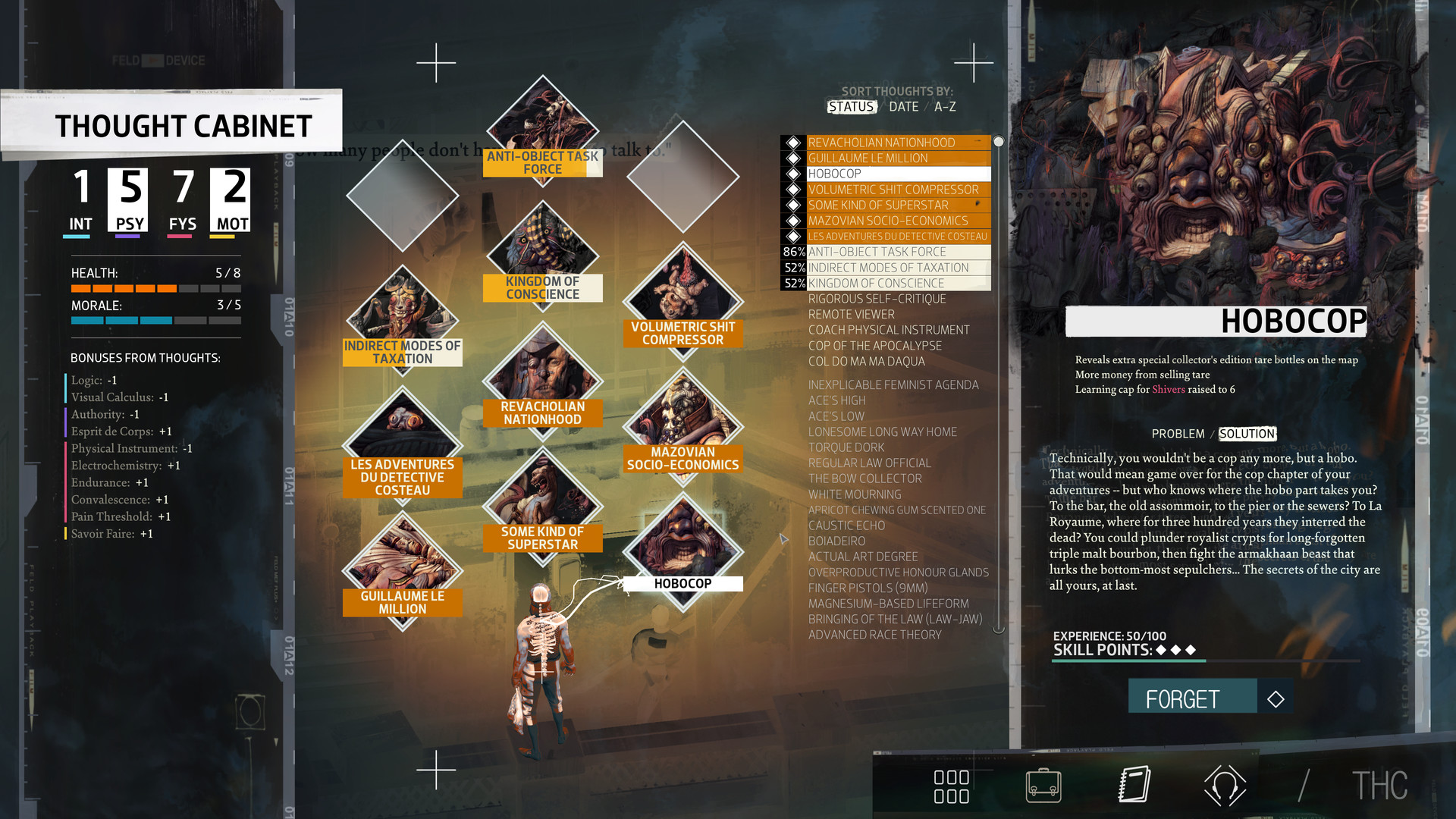
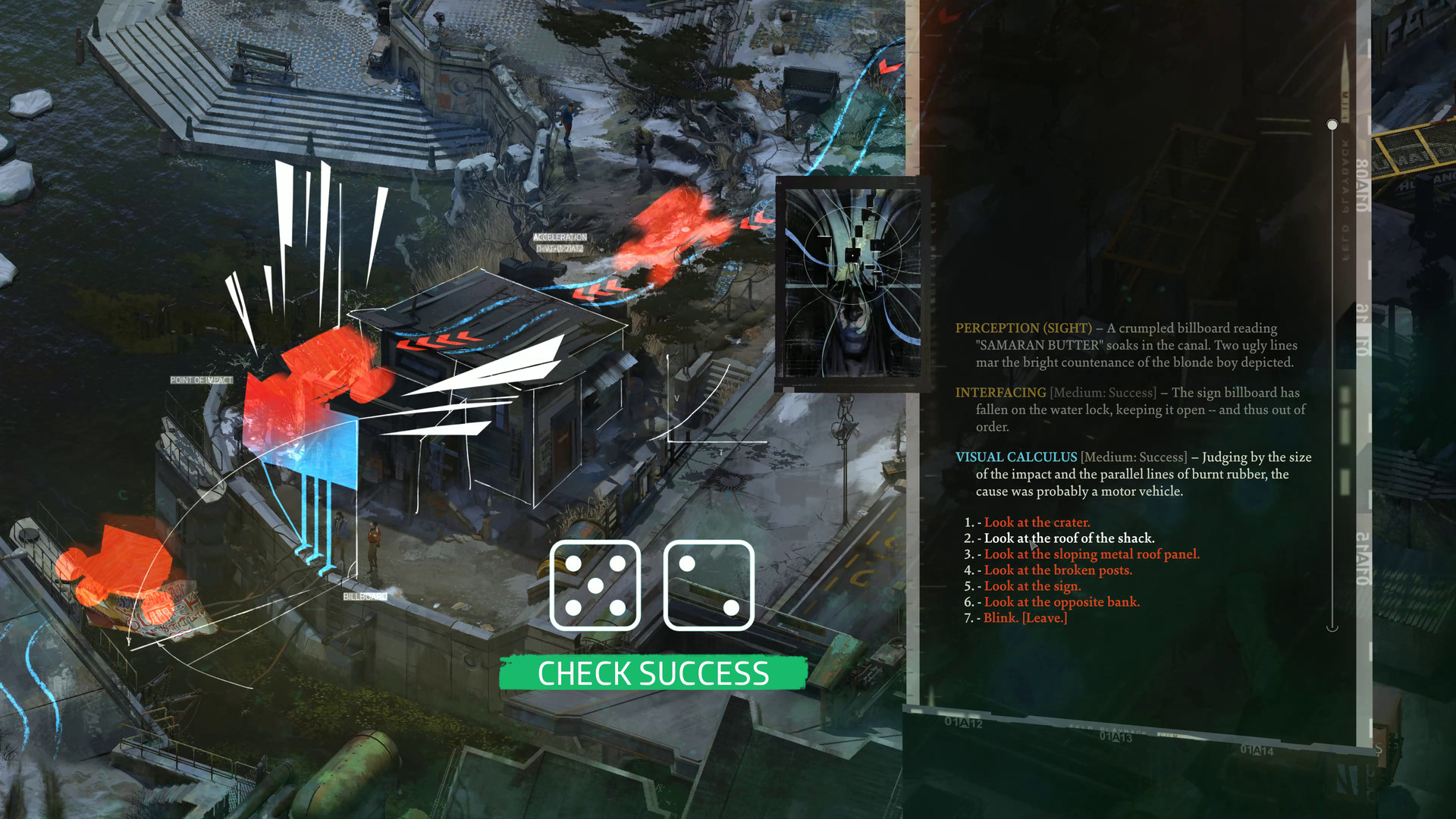
Disco Elysium has no combat. Instead, it has twenty-four character skills — and each of them has a voice. These are not passive stat modifiers. They are distinct personalities living inside your detective's head, competing for attention and offering commentary on everything that happens.
The skills are divided into four attribute groups:
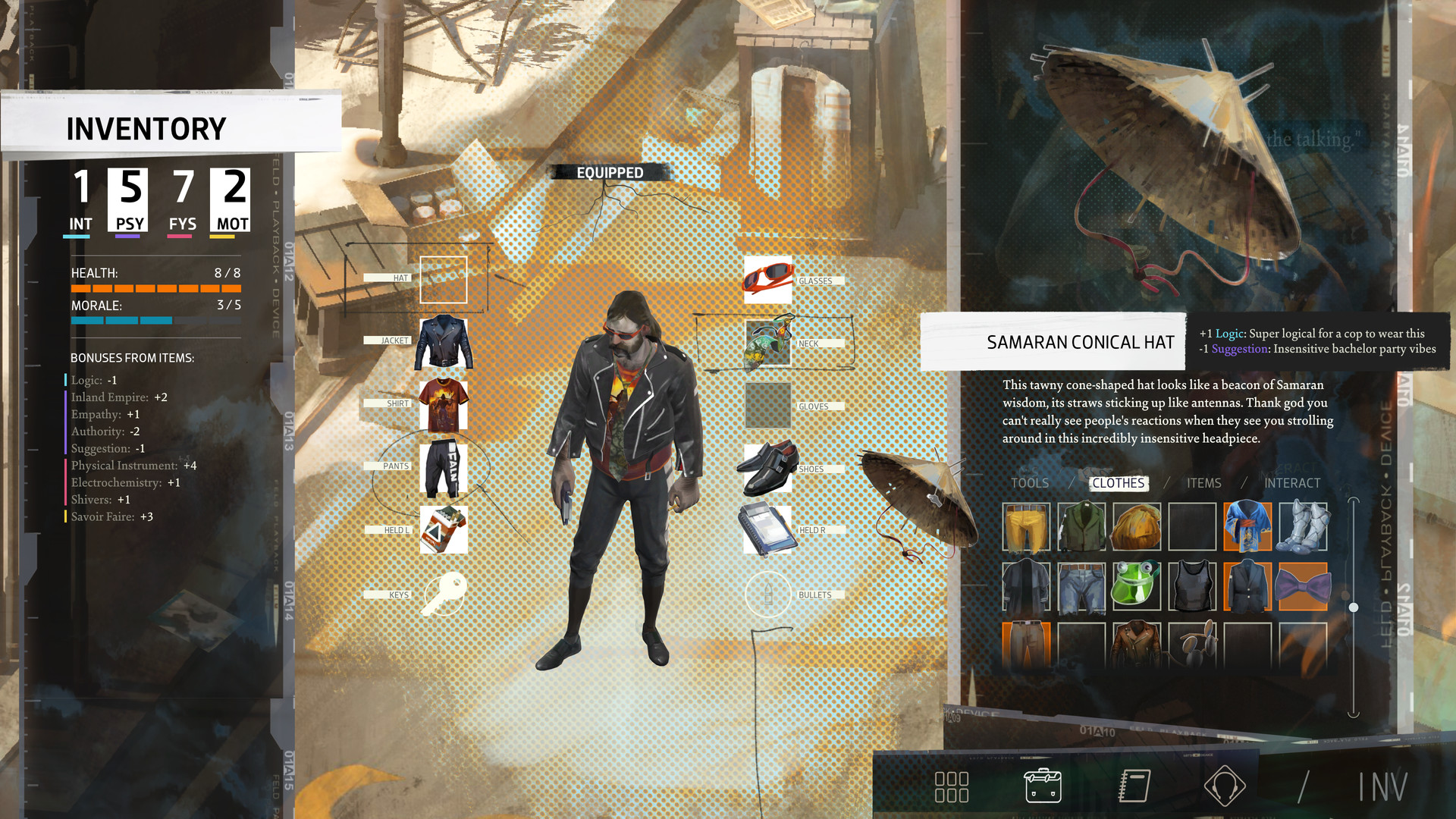
Intellect (blue): Rhetoric, Logic, Encyclopedia, Drama, Conceptualization, Visual Calculus. These skills analyze, theorize, and explain. Logic hunts for contradictions. Encyclopedia offers background knowledge on demand, whether you want it or not. Drama reads whether people are performing — and coaches you on performing yourself.
Psyche (purple): Volition, Inland Empire, Empathy, Authority, Suggestion, Esprit de Corps. Volition is the voice that keeps you from completely falling apart. Inland Empire is hallucinatory, intuitive, and often correct in ways that cannot be rationally explained. Empathy reads emotional states in others and often tells you things people are not saying aloud.
Physique (red): Endurance, Pain Threshold, Physical Instrument, Electrochemistry, Shivers. Electrochemistry is the voice of every appetite and addiction — it urges you toward substances, pleasure, and vice, and it is disturbingly persuasive. Shivers is something stranger: an ability to feel the city itself, its history and mood, as a sensory experience.
Motorics (orange): Hand/Eye Coordination, Perception, Reaction Speed, Savoir Faire, Interfacing, Composure. Perception notices what others miss. Composure keeps you from visibly falling to pieces under pressure.
The specific way each skill reads a situation differs dramatically. A high Shivers score means the wind off Martinaise harbor carries emotional weight — you feel the city's history in it. A high Inland Empire score means your necktie speaks to you, and what it says is not wrong. A high Electrochemistry score means every substance in the environment registers as a potential source of relief.
These voices interrupt each other, contradict each other, and sometimes reach disturbing agreement about things you would prefer to ignore.
The Thought Cabinet: Internalizing the World
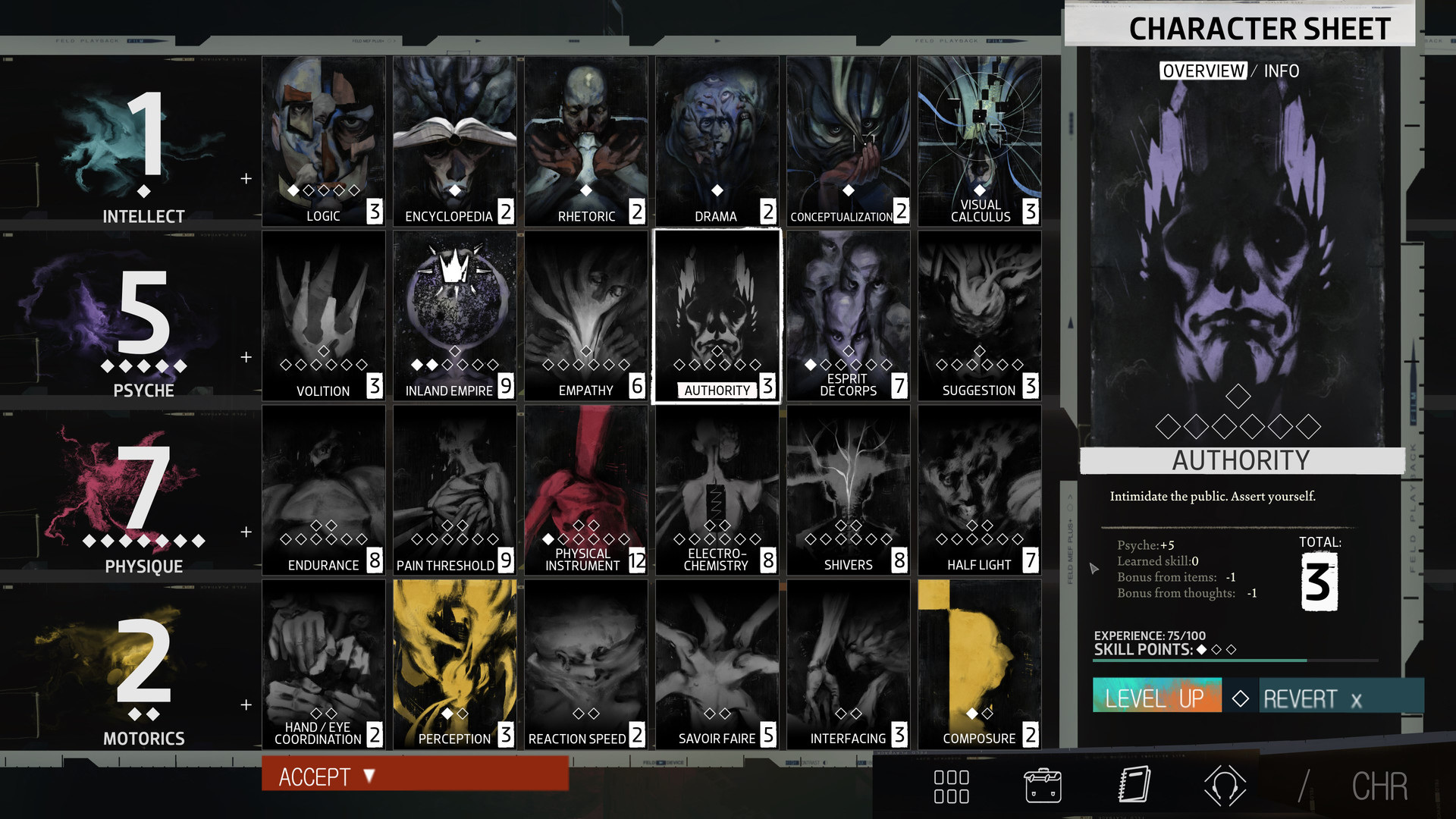
One of Disco Elysium's most distinctive mechanics is the Thought Cabinet. As you move through the world, your detective forms "thoughts" — conceptual frameworks for understanding what he encounters. Choosing to internalize a thought costs time and may produce uncomfortable cognitive effects during processing, but completing the internalization provides new skill bonuses, new dialogue options, and new ways of reading situations.
Some thoughts are practical and useful. Others are considerably darker. The game allows you to internalize a thought about fascism. It allows you to sit with the idea that you want to die, to process it, to emerge from it with a mechanical effect attached. This is not shock content — it is the game taking seriously the reality that people think about these things, and that sitting with uncomfortable ideas changes you in ways that can be mapped.
The Thought Cabinet is, in mechanical terms, a secondary progression system. Thematically, it is a model for how human beings process experience: by sitting with ideas, working through them, and emerging changed. It is the kind of design that makes you stop and think about what the developers are actually saying about consciousness and growth.
Certain thoughts unlock other thoughts. The combinations you choose compose a picture of who this detective is — what he believes, what he cannot stop thinking about, what he has decided to become.
Failure as Narrative — The Dice Are Not Your Enemy
Every significant action requires a skill check. Two dice roll; success or failure is determined by your skill level against a difficulty threshold. What distinguishes Disco Elysium from other dice-based systems is that failure is not a dead end. It is a different outcome.
Fail to intimidate a suspect and they dismiss you, walk away smirking — and something about the way they move gives you a clue you wouldn't have had otherwise. Fail a perception check and miss something crucial — but the experience of missing it, and what happens next, opens different paths. The game is designed so that an entirely successful run of skill checks would produce a worse, flatter experience than one with a healthy proportion of instructive failures.
This design philosophy removes the urge to save-scum your way to optimal outcomes. Every result is your result. Every stumble belongs to your detective.
Kim Kitsuragi — The Best Partner in Gaming
When you emerge from the wrecked hotel room, your partner is waiting. Kim Kitsuragi already knows what state you're in. He does not comment on it. He suggests you get to work.
Kim is one of the best-written characters in this game or any other. He is precise, professional, and rigorously controlled — not cold, but contained. Over the course of the game, small things emerge from beneath that control: a dry observation, a moment of something that might be warmth, a scene late in the game that is quietly unforgettable.
The relationship with Kim is the emotional spine of Disco Elysium. Your choices affect his trust, and losing that trust is possible. The game makes you feel his presence so consistently that the thought of disappointing him has a real weight. Many players report that some of their choices were determined not by what they wanted but by what they thought Kim would think.
The community's affection for Kim Kitsuragi has become something of a legend in gaming. He regularly appears in "best NPC" lists. Fan art, fiction, and creative work dedicated to him continues years after the game's release. "I didn't make that choice because Kim would disapprove" is a sentence that appears in reviews and forum posts with striking frequency.
Ideology and Political Vision — Four Ways to Read the World
Disco Elysium is one of the most thorough treatments of political ideology in the history of the medium. Four major pathways structure your detective's worldview, and each reads Martinaise and its conflicts differently:
Communist: You take the side of the dockworkers. You see the Pale Company as the face of a system that treats human beings as variables in a profit calculation. You form genuine solidarity with the strikers. But this route also demands confrontation with the gap between ideal and reality — the revolution failed, and you have to understand why.
Fascist: You pursue order, strength, and authority. This is the game's most uncomfortable route, because Disco Elysium is not content to simply present fascism as a strawman. It shows you what makes it compelling from the inside, and then shows you where that leads. It is genuinely difficult content.
Moralist: The centrist path. Rule of law, moderate reform, institutional trust. The game's sharpest observation about moralism is that choosing not to have a strong ideological position is itself an ideological position — one with its own beneficiaries and its own blind spots.
Ultraliberal: Free markets, individual interest, rational self-benefit. You align with Dora Cuarell's worldview. The route is internally consistent in a way that is progressively, deliberately disturbing.
The Final Cut added dedicated Political Vision Quests for each pathway — full questlines that push each ideology to its logical extreme and ask you to live with the result. These are among the game's most memorable sequences.
The Final Cut: Full Voice and Political Vision Quests
The Final Cut version added full voice acting to all one million-plus words of dialogue — a massive undertaking that transformed the experience from a text-heavy RPG into something approaching an interactive audio drama. The performances are exceptional across the full tonal range, from mordant comedy to genuine pathos.
Each of the twenty-four skills has a distinct vocal character. Inland Empire speaks in a soft, dreaming register that sounds like something heard through a wall at night. Electrochemistry is persuasive and seductive, the voice of everything that could make you feel better right now. Physical Instrument is blunt and immediate, speaking the language of force. Volition is the voice that sounds tired but has decided not to give up.
When multiple skills intervene simultaneously — which happens frequently — the effect is a genuine internal debate, staged entirely in voice. It is a technical and dramatic achievement that makes the text-based original feel even more complete in retrospect.
Legacy and Current Status — A Unique Moment That May Not Repeat
Disco Elysium won GOTY recognition from The Game Awards, BAFTA, GDC, DICE, and much of the major gaming press in 2019. Its Metacritic score of 97 remains among the highest ever recorded for a video game. It did not merely win awards — it changed the conversation about what games could be.
What followed is a story with a difficult ending. The core creative team behind the game — lead writer Robert Kurvitz and his collaborators — left ZA/UM following reported internal conflicts over the company's direction. They have since formed a new studio. The prospects for any sequel produced by the original creative team are unclear.
The practical implication is significant: Disco Elysium may represent a singular moment — one specific group of people, with a specific vision, producing something that could not have been made any other way. That is not a reason to feel sentimental. It is a reason to recognize what you are engaging with when you play it.
The Art Direction: A World Painted in Oils
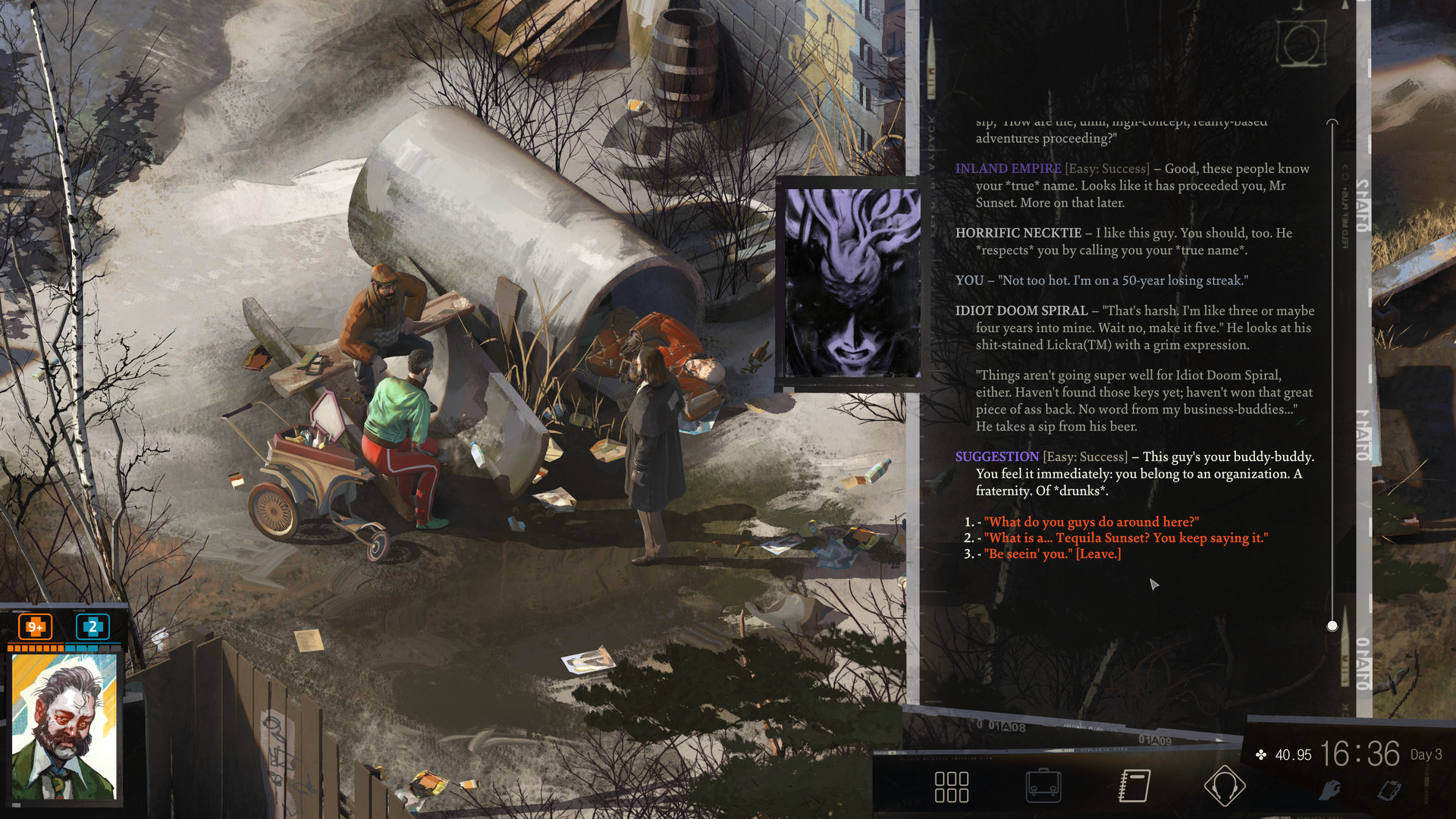
Disco Elysium's visual design is unlike any other game in the medium. The environments are rendered in a style that resembles oil paintings — loosely defined, expressive, rich in color and texture. Martinaise's grimy harbor, the hotel interiors, the industrial ruins and the protest encampment all feel like locations from a novel that someone decided to make visible.
The character portraits are especially distinctive. Each major character is rendered in a style that captures personality as much as likeness — the slant of an eye, the set of a jaw, the particular way exhaustion reads on a face. These portraits do not look like character art from a conventional RPG. They look like something a literary illustrator would produce for a serious novel about politics and failure.
The art direction was handled in-house by ZA/UM's visual team, and the consistency of vision across thousands of items, locations, and characters is remarkable given the game's indie scale. It is one of the strongest arguments that the game could only have been made by the specific team that made it.
This Game May Not Be for You — And That's Fine
Disco Elysium demands something most games do not: the willingness to read at length, to sit in uncertainty, and to engage with ideas rather than just actions. If you come to games primarily for mechanical challenge or fast-paced action, this game will frustrate you within the first hour. There is no combat. Progress is measured in conversations and revelations rather than levels and loot.
But if you are willing to give it what it asks — patience, curiosity, a tolerance for political philosophy delivered through a cast of weirdos and failures — it offers an experience genuinely unlike anything else in the medium. It is the rare game that changes how you think about what games can say.
Practical Guidance Before You Begin
- ▶Read everything: The prose in this game is the game. Skimming dialogue to get through to the "gameplay" misses the point entirely.
- ▶Check your Thought Cabinet regularly: Internalizing thoughts takes time in-game but provides compounding benefits worth planning around.
- ▶Don't fear skill checks: The dice exist to create variance, not to frustrate you. Trust the failure states as narrative.
- ▶Follow the Political Vision Quests: These questlines in the Final Cut are among the game's best content and require deliberate engagement to unlock.
- ▶Your second playthrough will be different: The game has sufficient branching that a return visit, even to familiar early sections, produces new dialogue and different outcomes. The replay value is genuine.
- ▶Plan a second run: Different attribute distributions produce fundamentally different games. A high Physique, low Intellect detective encounters Martinaise in a way that is almost unrecognizable from an Intellect-primary run.
Community Reaction
The community response to Disco Elysium has a quality that distinguishes it from most game discourse. "I couldn't play anything for days after finishing it" appears with unusual frequency in player accounts. The emotional residue the game leaves is that persistent.
Kim Kitsuragi has become one of the most beloved characters in gaming. The volume of fan work dedicated to him — art, fiction, analysis, discussion threads — has continued steadily for years after release. The sentence "I made that choice because Kim would have wanted me to" is, in its way, the best possible testimony to what the game achieves with its characters.
The debates the game generates about its political content are, largely, the debates it is designed to generate. Players argue about which ideological route is most honest, most correct, most complete — and those arguments are the point. A game that makes players argue seriously about political philosophy over a murder mystery set in a decaying harbor district has accomplished something genuinely unusual.
Final Verdict — Literature in the Form of a Game
Disco Elysium: The Final Cut is the most fully realized argument that video games can do something with the concept of player identity that no other storytelling medium can. The detective you build — through choices, through skill investments, through the failures you accumulate — is uniquely yours. His case, his politics, his slow reconstruction of self from the rubble of a man who drank himself into oblivion, is a story that could not be told in this way in any other format.
At this price point, it is an extraordinary value. At any price, it is one of the most important games made in this era. Given the circumstances surrounding its creators, it may be the only game of its exact kind that will ever exist.