Editor's note: this article summarizes published reviews, store data and community reception. GamePeak did not run its own playtest, so no GamePeak score is given.
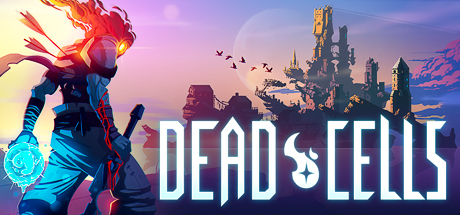
# Dead Cells — The Roguelike-Metroidvania That Never Gets Old
A Game That Found the Exact Right Formula
Some games are fine at a hundred things. A rare few are perfect at one. Dead Cells belongs to a third, smaller category: games that invent a formula so precisely calibrated that they become the benchmark for everything that follows in their genre.
Motion Twin, a French cooperative studio of under a dozen people, spent two years in Early Access refining Dead Cells before its August 2018 full release. The result sold 10 million copies across all platforms. It holds an Overwhelmingly Positive rating on Steam. It has been ported to mobile, expanded with multiple DLC packs, and inspired an animated series. And it remains, six years on, one of the cleanest realizations of what a hybrid roguelike-Metroidvania can be.
The core question Dead Cells answers is: what if a Metroidvania kept its best quality (the sense of getting stronger and unlocking access) while replacing its weakest quality (retreading the same corridors) with the variety of a roguelike? Every run is different. Every run builds toward something permanent. And every run is brutally, satisfyingly difficult in a way that makes you want to immediately try again.
The World and the Story (Such As It Is)
You are the Beheaded — a prisoner whose head has been severed, but whose consciousness survives inside a blob of living slime that animates corpses. You wake up in the prison of a diseased, plague-ridden island kingdom whose king has made catastrophic decisions, and you fight your way out.
The lore of Dead Cells is told almost entirely in environmental details, brief text scrolls, and scattered notes. The kingdom is dying. The plague that caused it has a history. The prisoners, soldiers, and monsters you encounter have their own relationships to that history. None of it is dumped on you. It rewards attention without punishing inattention — you can play hundreds of hours enjoying the game's systems and appreciate the worldbuilding purely as atmosphere.
The tone is its own thing: dark and oppressive in its imagery, but punctuated constantly with self-aware, often absurdist humor. The game knows you're going to die in it repeatedly, and it has opinions about that.
Core Gameplay: The Systems That Make It Work
Movement First, Always
Before anything else in Dead Cells, there is movement. Your character moves fast. The roll dodge has I-frames (invincibility frames) through its entire animation. You can wall-cling, double-jump, and use a parry shield to deflect projectiles. Movement is so central to the game's feel that the first thing a new player usually notices — before the weapon variety, before the biome design — is how good it feels to simply run through a corridor.
This isn't accidental. Motion Twin iterated on the movement system throughout Early Access, and the result is a character who feels athletic and responsive in a way that translates directly into gameplay satisfaction. Getting hit in Dead Cells almost always feels like a mistake you made, not an unfair imposition from the game. That distinction is everything in a roguelike.
The Weapon System and Build Crafting
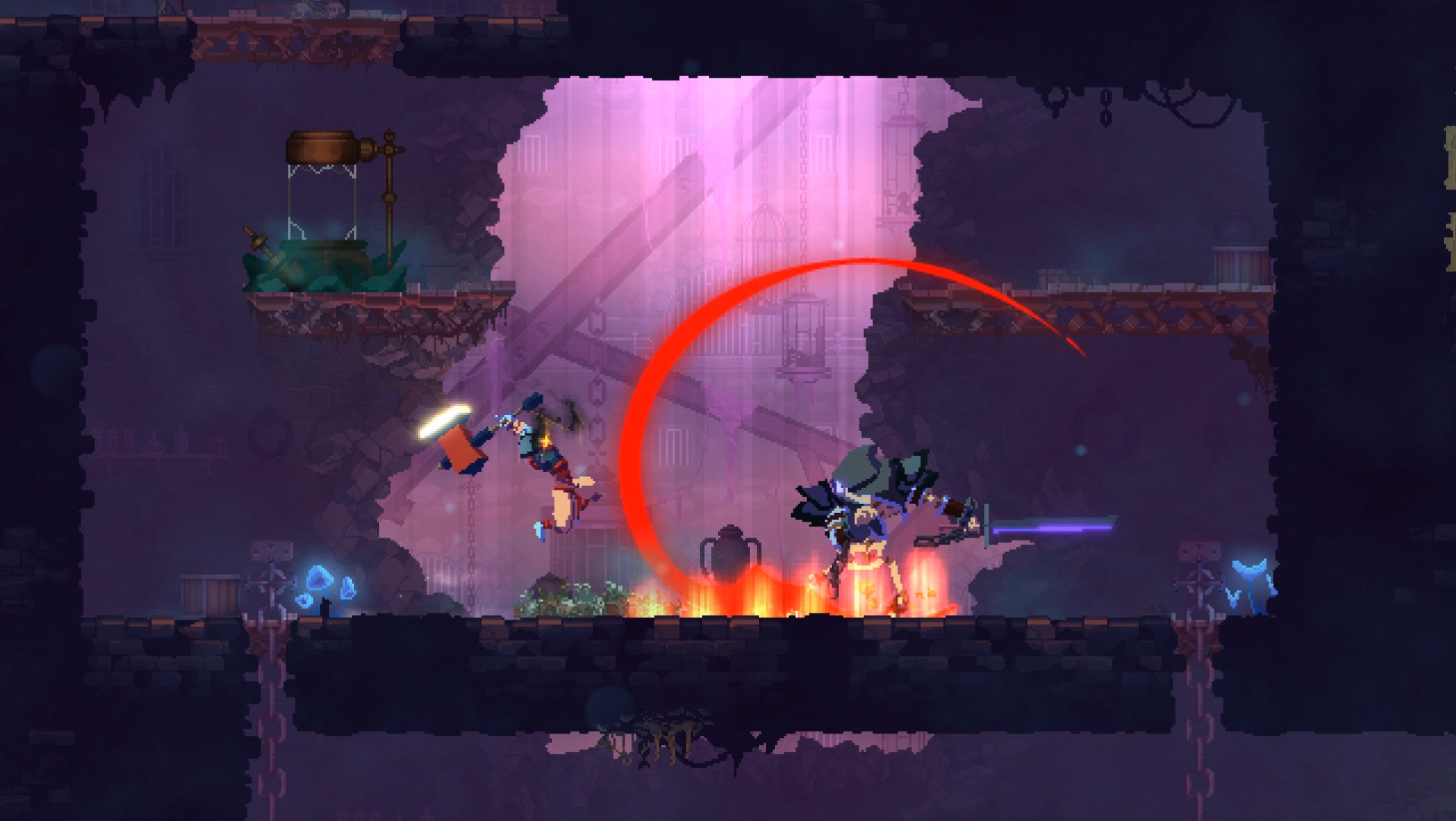
Each run equips you with up to two weapons, two skills (grenades, traps, turrets, shields), and two passive mutations. Weapons range from fast rapiers to slow broadswords, poison-applying whips, ice crossbows, flamethrowers, boomerangs, and dozens more — each with distinct attack patterns and timing requirements.
The genius of Dead Cells' weapon design is the synergy system. Weapons and skills interact. Freeze an enemy with an ice grenade and then apply a sword's "deal extra damage to immobilized enemies" property. Apply bleed damage with a whip, then trigger a "bleed explosion" mutation that detonates bleeding enemies for area damage. Stun an enemy with a shield parry, then activate a weapon that deals triple damage to stunned targets. Finding a synergy mid-run and leaning into it — pivoting your entire strategy around a combination you didn't start the run planning to build — is one of the purest highs the game offers.
The three color-coded scaling stats (Brutality/red, Tactics/purple, Survival/green) govern how powerful your equipment becomes. Weapons, mutations, and skills each scale with one or two of these colors. A cohesive build means getting your weapons and mutations pointing at the same color. An incoherent build means you're fighting at 60% effectiveness in the late game. Learning to read and pivot toward cohesion is the main skill that separates a player who reaches the final boss from one who doesn't.
The Permanent Progression Loop
Here is where Dead Cells resolves the central tension of roguelikes. In pure roguelikes, death means starting completely fresh — the knowledge you accumulated is your only reward. In Dead Cells, death means losing your current-run weapons and gold, but cells you've collected (the game's hard currency) unlock permanent upgrades: new weapons and skills that appear in future runs, extra health flasks, starting bonuses, stat boosts.
You are always getting stronger. A new player running the Prison for the first time will have far fewer weapon options than a veteran. The veteran's runs are different not just because they know the maps, but because their unlock pool is bigger and their starting loadout options are wider. Progress is real and visible — but the actual execution of each run is never automatic.
Boss Cell Difficulty: The Long Game
Completing the game unlocks Boss Cells — modifiers that stack increasing difficulty across subsequent runs. At one Boss Cell, enemies hit harder and there are more of them. At five Boss Cells (the maximum, sometimes called 5BC), the game is a fundamentally different experience: elite enemies appear early, trap rooms become lethal, certain weapons and synergies become mandatory.
The 5BC community plays what is effectively a different game from a newcomer's first-run experience, and yet both are playing the same game. The difficulty scaling is what gives Dead Cells its extraordinarily long legs — there is always a harder version of the challenge waiting once the current one is mastered.
The Biomes: A Tour of the Island
Each run takes you through a branching selection of biomes, with forks that let you choose your path through the island. Each biome has its own visual palette, enemy type, environmental trap layout, and ambient soundtrack.
- ▶The Prison — the starting biome. Stone walls, chains, desperate prisoners. The game's tutorial in disguise.
- ▶The Promenade of the Condemned — open air, trees, and archers who will ruin your day from offscreen.
- ▶The Ossuary — fire traps in every corridor. Beautiful and lethal in equal measure.
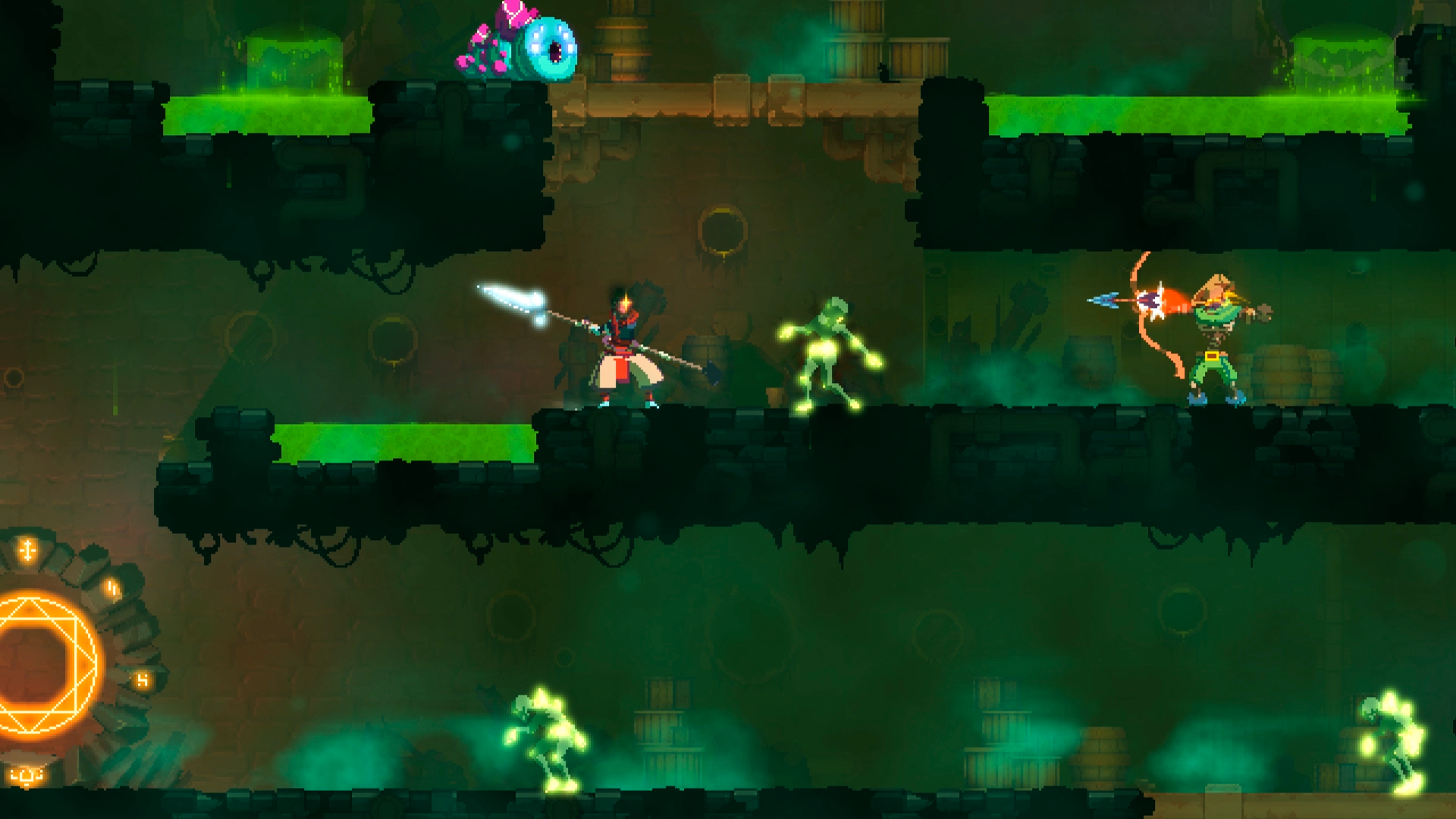
- ▶The Sewers — wet floors that affect movement, and enemies that emerge from pipes.
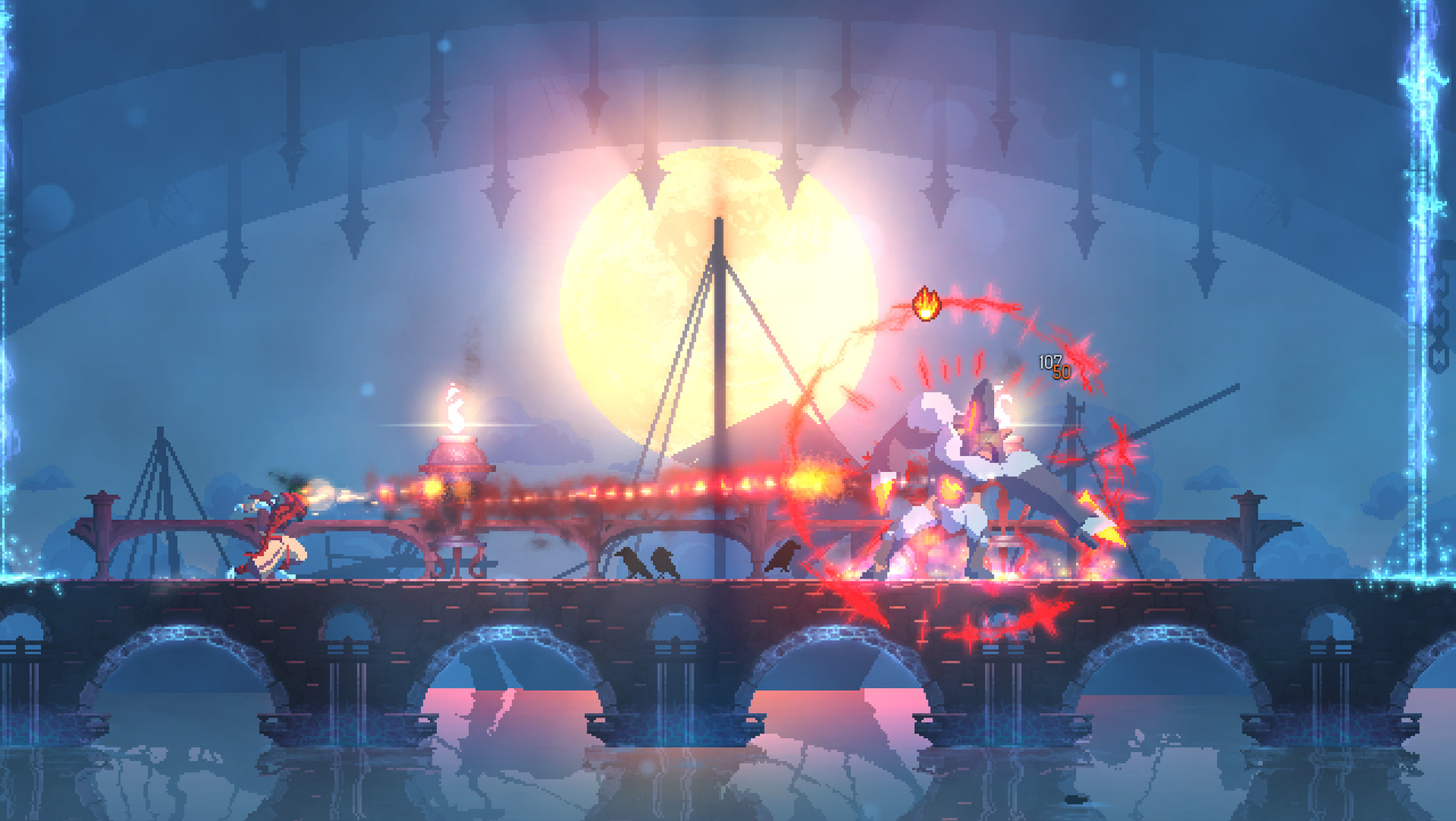
- ▶The Black Bridge — the first boss checkpoint. The Concierge, a massive armored jailer, is your first real test.
- ▶The Clock Tower — precision platforming in vertical shafts. One of the game's most atmospheric sections.
- ▶The High Peak Castle — the final stretch, enemy density at its highest.
No two runs trace exactly the same path, and the procedurally generated layout within each biome means the specific corridors are never identical. By the time you've played fifty runs, you know every enemy, every trap type, every biome — and the game is still surprising you with how they combine.
The DLC: More of the Right Things
Dead Cells has received multiple paid expansions that add new biomes, weapons, enemies, and bosses without disrupting the base game's balance:
- ▶The Bad Seed — adds a verdant, corrupted greenhouse biome and a boss designed around status effects.
- ▶Fatal Falls — adds two mid-game biomes with fresh enemies and movement mechanics.
- ▶The Queen and the Sea — adds two late-game biomes and a second true ending.
- ▶Return to Castlevania — the crown jewel: a full crossover with Konami's Castlevania series, adding Alucard as a playable companion, weapons from the Belmont lineage, enemies from Symphony of the Night, and remixed versions of iconic Castlevania music. It is the best licensed crossover DLC in recent memory.
All DLC is optional and does not gate the main game's story or difficulty progression.
Tips for New Players
- 1Roll through everything. The I-frames on your dodge roll are generous. When in doubt, roll through the attack rather than trying to jump over it or back away.
- 1Parry shields are not optional early. The Soldier's Shield and other parry tools are training wheels for the game's timing — use them until you've internalized the enemy attack patterns.
- 1Pick up every scroll you find. Scrolls are the primary stat boosters found in each biome. Never skip a scroll pickup. Each one represents a meaningful percentage increase in your damage output.
- 1Look for synergies, not just good weapons. A mediocre weapon that synergizes with your mutation is better than a high-tier weapon that doesn't. The build matters more than the individual pieces.
- 1Don't panic spend your cells. It's tempting to unlock every weapon option immediately. Prioritize the extra health flask upgrades first — survivability unlocks give you more runs per session to learn the game.
- 1Watch what kills you. Every death in Dead Cells is information. The enemy that got you has a tell. Find it on the next run and use it.
Community Reception
Dead Cells holds an Overwhelmingly Positive rating on Steam (97%) across well over 100,000 reviews — one of the highest-rated games in Steam's history in terms of both score and review volume. The phrase "Overwhelmingly Positive" is one of Steam's rarest designations, and it reflects a game whose flaws are nearly impossible to find fault with in reviews.
The Metacritic score is 89 for the PC version, with the Nintendo Switch version scoring 91. Critics consistently cite the movement feel, weapon variety, build crafting depth, and the remarkable balance between accessibility and depth as the game's defining achievements. The Return to Castlevania DLC received particular praise for how thoughtfully it integrated with a pre-existing game.
The Dead Cells community remains active, producing build guides, speedrun records, and content around the game years after its release. The announcement of an animated series (in pre-production) speaks to how far the franchise's cultural footprint has extended beyond gaming circles. Motion Twin's successor project, Windblown, inherits the studio's design philosophy — the influence is visible.
Why This Is a GamePeak Pick
Every GamePeak Pick needs to answer the same question: is there a reason to play this today, not just a reason it was important when it launched?
Dead Cells answers affirmatively and immediately. It is available on every major platform. Its price point is accessible. The content volume — especially with DLC — represents hundreds of hours of genuinely escalating challenge. And it remains the clearest expression of what a roguelike-Metroidvania can be, even as the genre it essentially defined has grown to include dozens of successors.
If someone asks you to recommend a game that will teach them why roguelikes are compelling, Dead Cells is the answer. If someone is already deep into the genre, Dead Cells is still where the ceiling is. That range is rare and it is why it belongs on this list.
Final Verdict
“Dead Cells is the kind of game that doesn't need a sequel to feel complete — and that's the highest praise you can give a roguelike. It's fast, deep, beautiful, and perpetually fresh. Ten million copies sold and an Overwhelmingly Positive rating are not flukes: this is a game that delivers on every promise it makes, across hundreds of hours. An unqualified GamePeak Pick.